
 By
By The year is 2026. The video game industry finds itself at a fascinating crossroads. On one side, you have the crushing pressure of AAA development budgets ballooning past $200 million, development cycles stretching five years or more, and teams of hundreds struggling to populate vast worlds with enough content. On the other side, you have generative AI, a technology that promises to solve these problems but brings its own baggage: copyright chaos, ethical landmines, and the dreaded “AI slop” label that players have learned to spot from a mile away.
Into this maelstrom steps Capcom. The company behind Resident Evil, Street Fighter, and Monster Hunter has done something unusual in 2026: it has drawn a line in the sand. In a series of shareholder briefings and interviews, Capcom articulated a clear, nuanced position. It will embrace generative AI aggressively for internal processes but refuses to let AI-generated assets appear in its finished games. This isn’t technophobia or Luddism. It is a calculated, thoughtful strategy that could define how the rest of the industry navigates the next decade.
Capcom’s Approach to Generative AI
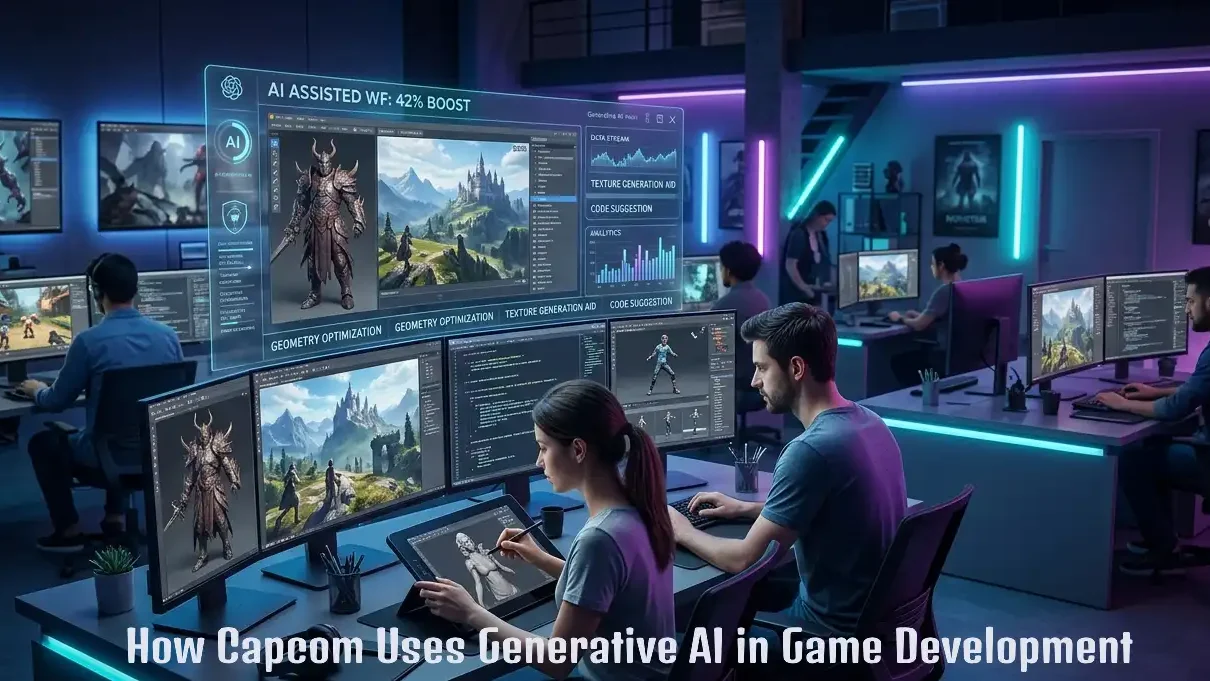
Let’s be clear about what Capcom is doing because the headlines can be misleading. In March 2026, during a shareholder Q&A session, the company made its position unambiguous. “Our company will not implement the materials generated by our AI into game content,” Capcom stated flatly. But the next sentence is just as important. “However, we plan to actively use this technology to improve efficiency and productivity in the game development process. That is why we are currently testing out various methods of usage across our departments, including graphics, sound, and programming.”
This is the critical distinction: AI-assisted development versus AI-generated content. Capcom uses generative AI as a collaborator for its developers, not as a replacement for them. As VP Shinichi Inoue told 4Gamer: “What we in the entertainment industry consider extremely important in contrast to artificial intelligence is human sensibility. Even top-tier AI still cannot match our creators when it comes to sensibility. That’s the current reality.”
Why Capcom Is Exploring Generative AI
Since 2017, the cost and development time for AAA games have nearly doubled. Resident Evil Village reportedly cost over $110 million. Monster Hunter: World required hundreds of artists over years. Player expectations demand hundreds of thousands of unique ideas per open-world title. Doing everything by hand is becoming impossible.
Capcom isn’t exploring AI out of hype—it’s out of necessity. Generative AI dramatically compresses timelines for repetitive, non-creative tasks. If an AI generates fifty placeholder environment concepts in thirty seconds, a human artist can spend those hours refining a hero character. Moreover, Kazuki Abe, Capcom’s technical director, described a prototype “idea generation” system that reads design documents and produces visual references, helping teams brainstorm faster.
How Capcom Uses Generative AI During Development
Automated Playtesting & QA (The Real Game Changer)
Capcom’s multi-agent system runs continuously in the background, playing the game and predicting breakpoints. When an issue is found, a “debugging check agent” validates it against the director’s vision. This system processes ~30,000 hours of testing work monthly, running while developers sleep and delivering only the most relevant findings in the morning.
Research and Information Gathering
Developers need historical, architectural, or mechanical references. AI tools connect to internal knowledge bases and synthesize accurate data in minutes rather than hours, freeing designers to focus on implementation.
Documentation & Meeting Summaries
Automatic transcription and summarization of internal meetings ensure action items never slip. This reduces overhead and keeps distributed teams aligned.
Programming and Debugging Support
AI-assisted code completion, refactoring suggestions, and bug detection accelerate programming. Every AI suggestion is reviewed by human coders before integration.
User Data Analysis & Player Insights
Massive telemetry data gets analyzed by machine learning models to spot player friction, difficulty spikes, and churn patterns – empowering designers to make data-informed adjustments.
Why Capcom Avoids AI-Generated Assets in Finished Games
Artistic Quality & “Sensibility”: Inoue was direct: “Even top-tier AI still cannot match our creators when it comes to sensibility.” AI lacks intentionality and emotional depth — central to Resident Evil‘s dread or Monster Hunter‘s creature believability.
Copyright & IP Minefields: Legal uncertainty around training data and output rights means using AI-generated assets in commercial products invites liability. Capcom keeps AI strictly internal.
Brand Reputation & Player Trust: When generative AI slips into games (even as placeholders), fan backlash is immediate. Capcom has built a 40-year reputation on human artistry — they are unwilling to risk “AI slop” labels.
Creative Authenticity: The struggle of hand-crafted design leads to breakthroughs. Outsourcing to AI risks atrophying the very skills that define Capcom’s legacy.
Benefits of Generative AI for Game Development (Capcom’s realized gains)
- Massive productivity boost: Tens of thousands of hours of testing moved to AI, humans focus on high-value features.
- Faster iteration cycles: Placeholder concepts in seconds → experiment rapidly → converge on better designs.
- Reduction of repetitive toil: No more manually crafting hundreds of identical background rocks or writing boilerplate functions.
- Better resource allocation: Top talent works on memorable characters, environments, and systems.
- Data-informed design: AI analysis of player behavior leads to better balance and engagement.
Challenges and Risks of Using Generative AI
Hallucinations & inaccuracies: AI can be confidently wrong. Code suggestions may contain subtle bugs, meeting summaries might invent action items. Human oversight is mandatory.
Security concerns: Cloud AI requires sharing sensitive pre-release data with third parties. Capcom must vet every tool to avoid leaks.
IP contamination risk: Even internally, an AI-generated creature concept that accidentally resembles another company’s copyrighted design could create legal gray zones.
Skill erosion: Over-reliance may cause new developers to skip learning fundamentals. Capcom combats this by keeping AI as an assistant, not a crutch.
How Capcom Compares with Other Gaming Companies
According to Google Cloud’s Jack Buser, roughly 90% of major studios use AI in some development capacity, but many hide it due to audience fears. The spectrum includes:
- AI-Embracers: Pearl Abyss accidentally shipped AI-generated assets in Crimson Desert; Ubisoft admitted placeholder AI image in Anno 117.
- Productivity-focused: Square Enix explores internal AI workflows similarly to Capcom.
- Resistors: Some indie studios refuse generative AI entirely based on ethics.
Capcom stands out for transparency and red lines: it’s vocal about using AI for efficiency while publicly guaranteeing zero AI assets in shipped products.
What Capcom’s AI Strategy Means for the Future of Gaming
Capcom’s hybrid model — human + AI — is likely the industry’s long-term norm. Developers will shift from manual labor to training, supervising, and collaborating with AI agents. The role of QA evolves into AI behavior training; artists become system designers for procedural variation. This approach preserves the “soul” of game development while embracing necessary automation. Capcom’s policy could serve as a responsible blueprint for others: automate the drudgery, never the artistry. As the company’s leadership puts it: sensibility remains irreplaceable.
Frequently Asked Questions
Yes, Capcom actively uses generative AI for internal processes: automated playtesting, code assistance, idea generation, meeting summarization, and data analysis.
No. Capcom has officially stated that it “will not implement any AI-generated assets into its video game content.” All final assets are crafted by human artists.
AI helps by handling massive playtesting (30k+ hours/month), generating placeholder concepts, summarizing meetings, providing debugging suggestions, and analyzing player telemetry.
Not at Capcom. The company has positioned AI as a productivity tool — “Even top-tier AI still cannot match our creators when it comes to sensibility,” says Shinichi Inoue.
Faster iteration, reduced repetitive work, improved testing coverage, data-driven design, and the ability to redirect human effort toward creative, high-impact tasks.
Conclusion: Keeping Humanity at the Center
Capcom’s approach offers a masterclass in responsible technology adoption. The company has looked at the same productivity pressures as every major publisher. But it also asked: What makes our games special? The answer has led Capcom to a distinctive position: use AI aggressively but only behind the scenes. Automate the drudgery, never the artistry. As Capcom’s developers put it, “Even top-tier AI cannot match our creators when it comes to sensibility.” That sensibility—the uniquely human ability to feel, judge, and create meaning—is the entire point. In a race toward an AI-driven future, Capcom’s commitment to human creativity might be its greatest competitive advantage. Follow UKTechWire for more tips!

Jalees Ur Rehman is an SEO professional with 13+ years of experience in SEO and Digital Marketing. He helps businesses grow organic traffic and conversions through data-driven digital marketing strategies and practical execution.