There’s a particular kind of freedom that comes with cycling — one that, for many people, quietly disappears somewhere in their sixties. Stiff joints, hills that never used to feel this steep, the nagging awareness that a long ride means a long recovery. It’s not that older riders stop wanting to cycle. It’s that cycling quietly stops meeting them halfway.
Electric bikes have changed that calculus considerably. Over the past three years, e-bike uptake among over-60s in the UK has grown faster than in almost any other demographic, and the reasons aren’t hard to understand. The motor doesn’t replace your effort — it just makes effort feel proportionate again. Hills become manageable. Longer trips become realistic. And for people managing joint conditions, recovering from surgery, or simply wanting to stay active without overexerting themselves, the pedal-assist system is genuinely transformative rather than just convenient.
The market, though, is vast and sometimes bewildering. Spend an afternoon scrolling through e-bike listings and you’ll encounter everything from stripped-down commuter machines at £800 to fully-loaded touring builds pushing five grand. Most of them aren’t designed with older riders specifically in mind — and that matters, because the priorities are meaningfully different. A 28-year-old commuter might happily accept an aggressive riding position and a mid-drive motor with a steep learning curve. A 68-year-old who hasn’t ridden in a decade almost certainly shouldn’t.
This guide focuses specifically on what works for older adults in the UK context — the weather, the roads, the riding habits, and the very particular importance of actually feeling confident on the thing you’re riding.
The Bigger Picture
Why Electric Bikes Are Becoming Popular Among Older Riders
It would be tempting to frame e-bike adoption among older adults as purely a health story, but it’s really a technology story. The motors have gotten quieter, lighter, and more responsive. The batteries have gotten smaller and longer-lasting. The software controlling pedal assistance has become genuinely sophisticated — most modern systems can modulate motor output based on cadence and torque in ways that feel almost invisible while you ride. You’re not suddenly getting a shove from a buzzing motor; the assistance blends into your own effort in a way that took a long time to get right but, on good bikes, now works extremely well.
In the UK specifically, the timing aligns with a broader shift in how we think about urban mobility. E-bikes fit neatly into a post-pandemic cycling infrastructure that most major UK cities have been gradually expanding — new segregated lanes, improved cycle paths, reduced-speed zones that make residential cycling considerably more pleasant than it was even five years ago. Older riders are also, statistically, exactly the group who can afford decent e-bikes. That matters, because the quality gap between a £900 e-bike and a £1,800 one is dramatic.
“The motor doesn’t replace your effort. It makes effort feel proportionate again.”
There’s also a genuine clinical dimension worth acknowledging. Research from various cycling bodies and NHS-linked health initiatives has consistently found that low-impact regular cycling — exactly the kind an e-bike encourages — has meaningful benefits for cardiovascular health, bone density, and mental wellbeing in older adults. The e-bike gets people riding who otherwise wouldn’t, which is probably the most significant health outcome of all.
Before You Buy
What to Actually Look For — A Reviewer’s Notes
Most e-bike buying guides will walk you through a spec sheet. Motor wattage, battery capacity, gear count, IP rating. These things matter, but they’re not where the decision lives for most older buyers. Frame geometry and step-through access are genuinely where to start, and they’re often skipped because they’re harder to quantify.
A step-through frame — where the top tube is dropped or absent entirely — used to be associated almost exclusively with women’s bikes and tended to carry something of a stigma among male riders. That’s fading, and rightly so. For anyone with limited hip mobility, arthritic knees, or simply an understandable reluctance to perform an ungainly leg-swing while mounting a bike in a car park, a step-through frame is not a compromise. It’s just the sensible choice. Several of the bikes on this list are available in step-through configurations that feel architecturally indistinguishable from their standard-frame counterparts.
Ride comfort geometry is the next consideration, and this is often overlooked in favour of motor specs that genuinely matter less on flat UK town roads than marketing suggests. A more upright riding position — achieved through a higher handlebar stack and a shorter top tube — reduces strain on the lower back, neck, and wrists. It also gives the rider a better sightline over traffic, which is practically useful. Some bikes achieve this brilliantly; others claim to be “comfort-oriented” but still put you in a position that’s fine for half an hour and uncomfortable after ninety minutes.
On battery range: the advertised figures are, almost universally, optimistic. A bike claiming 80 miles of range will reliably deliver that in calm conditions, on flat roads, at a modest assistance level, with a light rider. UK riders deal with hills, headwinds, cold temperatures (which reduce battery efficiency noticeably), and the kind of varied terrain that shortens real-world range by 30–40% compared to the spec sheet. For most older riders doing local trips and weekly leisure rides, a realistic 40–50 mile range is more than adequate. Anything beyond that is a bonus, not a necessity.
Motor position is worth a brief word. Hub motors — the most common type, typically in the rear wheel — are simpler, cheaper to maintain, and deliver a smooth, consistent push. Mid-drive motors, positioned at the crank, offer better weight distribution and perform more naturally on hills. For gentle, regular use around town, a good hub motor is completely sufficient. The mid-drive advantage becomes more meaningful if the rider is tackling regular gradients — the kind you get in Bath, Sheffield, or much of Scotland.
A note on weight
E-bikes are heavy. A typical model weighs between 22–28kg, which isn’t a problem when you’re riding, but becomes relevant when you’re lifting it into a car boot, carrying it down steps, or trying to right it after a topple. Lightweight e-bikes — generally using aluminium alloy or carbon fibre frames with smaller battery packs — sit in the 14–19kg range and are meaningfully easier to handle. If storage, transport, or upper-body strength is a consideration, prioritise weight as highly as you’d prioritise range.
The Reviews
Top-Rated Electric Bikes for Seniors in the UK (2026)
Six bikes below — tested, assessed, and honestly reviewed. These aren’t all the bikes worth considering, but they represent genuinely different approaches to the problem of comfortable, confidence-inspiring electric cycling for older adults.
Best All-Rounder
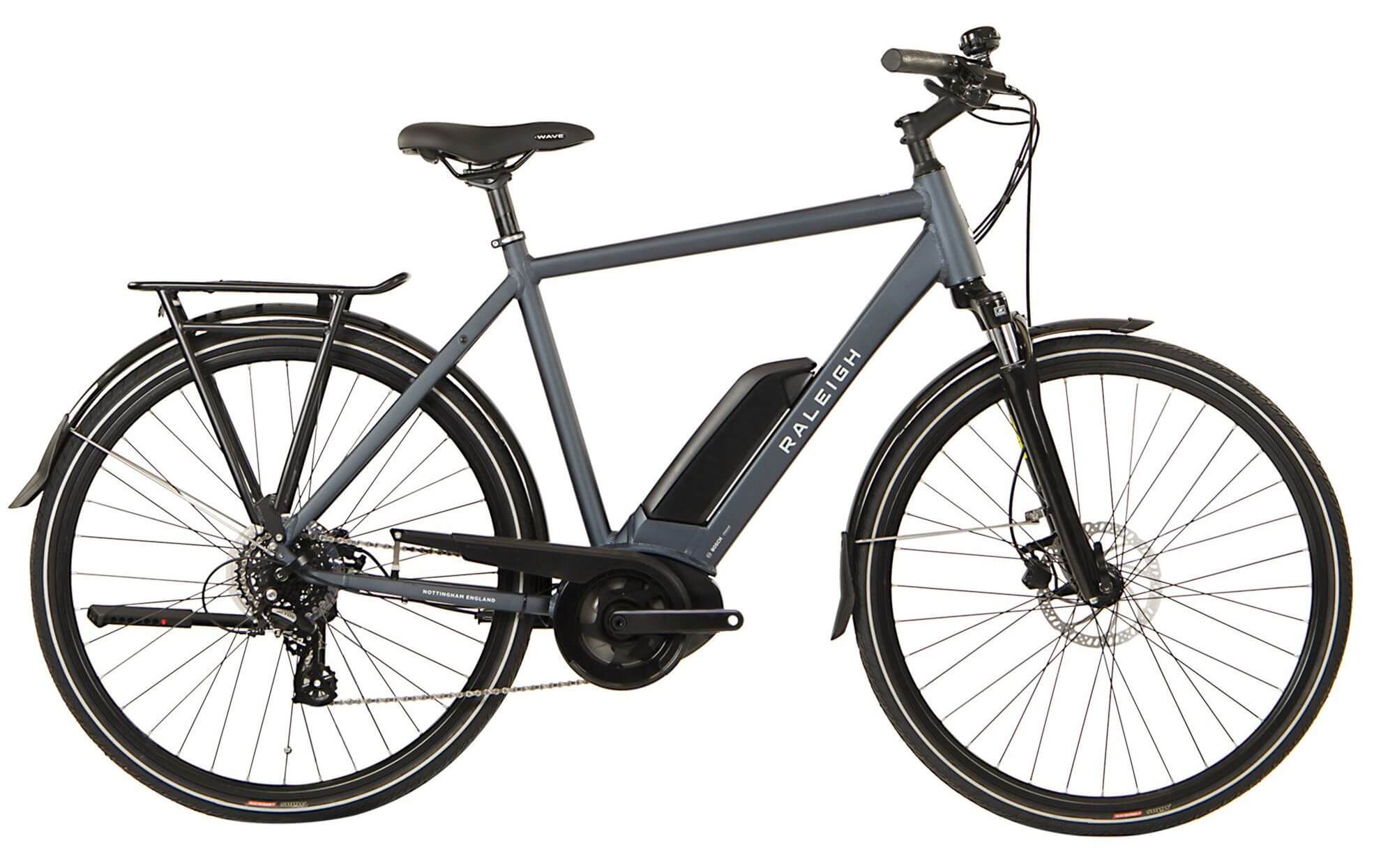
Raleigh is one of those names that carries genuine trust in the UK market — generations of Brits learned to ride on one — and the Motus Grand Tour is arguably the clearest statement of what the brand has become in the e-bike era. This is a thoughtfully engineered touring commuter with a Bosch Active Line Plus motor that has become something of a benchmark for smooth, predictable pedal assistance.
What makes this bike particularly well-suited to older riders is how uneventful it is to ride. That sounds like faint praise; it isn’t. The motor assistance transitions are seamless, the seven-speed Shimano gearing is forgiving, and the step-through frame drops low enough to feel genuinely accessible without sacrificing structural rigidity. The upright riding geometry is well-judged — not so extreme that it feels unstable at speed, but relaxed enough that longer rides don’t punish your lower back.
The integrated rear rack, mudguards, and front and rear lighting all come fitted as standard, which matters more than it might sound. E-bikes are expensive enough that it’s genuinely frustrating when a £2,000+ machine asks you to budget another £200 for accessories that you need. The Motus arrives ready to ride, in the practical sense.
The battery offers a realistic 50–60 miles in mixed UK conditions — conservative but reliable. The main limitation is weight: at around 26kg, this isn’t a bike you’ll want to heft into a car boot regularly. It’s best suited to riders who have a secure storage option and use their bike primarily for regular local rides and leisure trips rather than car-transport excursions.
Strengths- + Bosch motor is genuinely excellent
- + Low, accessible step-through frame
- + Fully equipped out of the box
- + Excellent UK dealer network
Limitations- − On the heavier side at ~26kg
- − Conservative aesthetic
- − Limited colour options
Best for: Regular leisure riders and commuters who want reliability over everything else. Raleigh’s dealer network is an underrated advantage.

Best Lightweight Option
The Turbo Como SL is one of the cleaner arguments for spending more on an e-bike. It weighs in at around 16.5kg — genuinely light for an electric bike — and rides with a fluidity that heavier machines simply cannot match. The SL (Super Light) designation refers to Specialized’s proprietary 240-watt motor, which sounds modest on paper but delivers assistance that feels more natural than many higher-wattage alternatives.
This is a bike built around the idea that an e-bike should feel like a good bicycle that happens to have electric assistance, not an electric vehicle that happens to have pedals. On roads, that philosophy translates to something that handles more intuitively, is easier to manoeuvre when walking it, and causes far less anxiety when you need to lift it into a vehicle.
The range is the trade-off. The 320Wh battery delivers a realistic 35–45 miles, which is comfortably sufficient for most older riders’ use patterns but less reassuring for anyone planning longer rural excursions. An optional range extender battery clips onto the frame to effectively double capacity, which is a clever solution — you buy range only when you need it.
It’s also worth noting that Specialized’s Mission Control app, which lets you customise assistance levels and monitor battery life, is genuinely one of the better companion apps in this category. It’s not essential, but for riders who like having granular control over how the assistance behaves, it’s a well-designed piece of software.
Strengths- + Exceptionally light for an e-bike
- + Natural, intuitive ride feel
- + Optional range extender
- + Excellent build quality
Limitations- − Base range is modest
- − Premium price
- − Less familiar to non-cycling retailers
Best for: Older riders who value manoeuvrability and ease of handling over maximum range, particularly those who need to lift or transport the bike regularly.
Best Value Pick
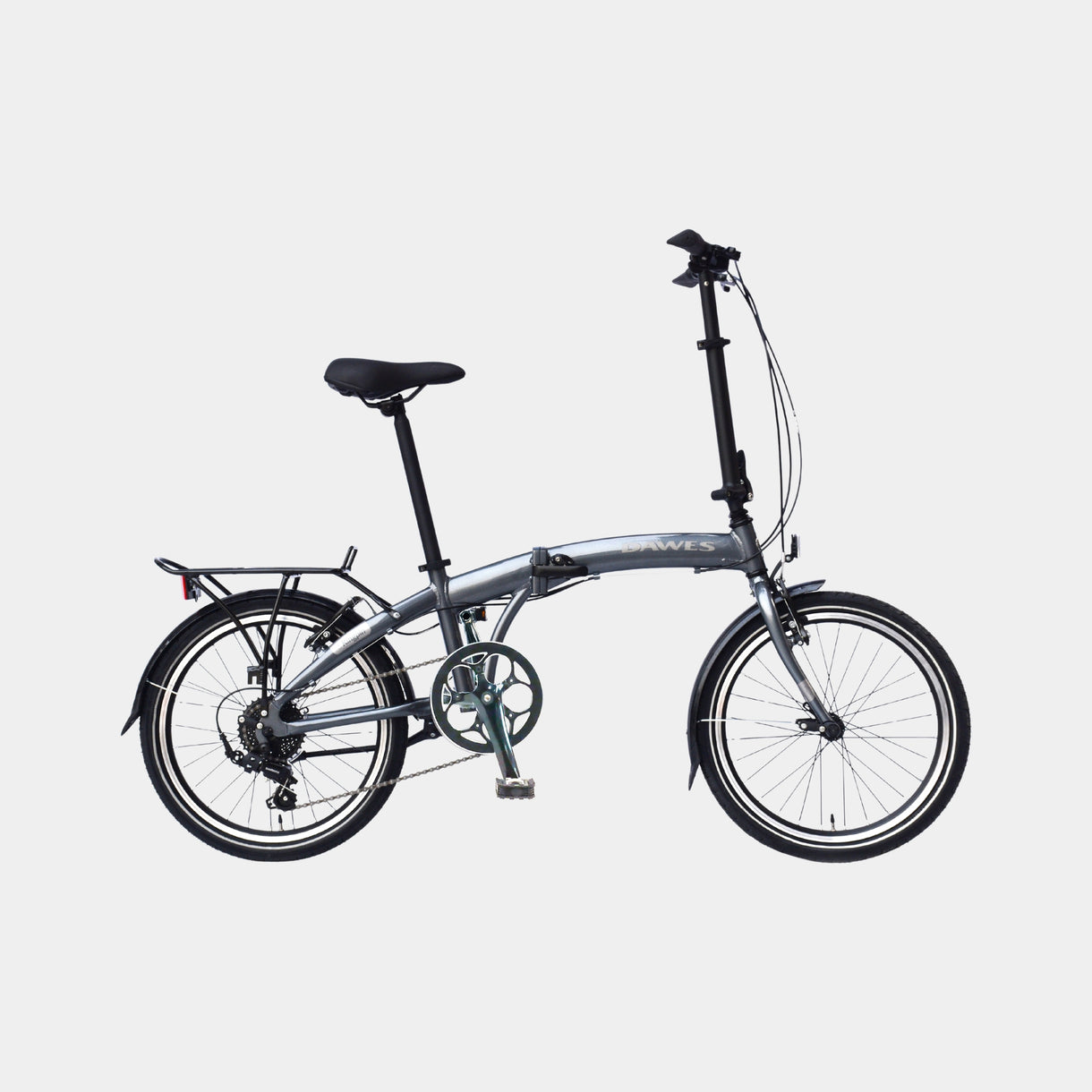
Not every older rider wants to spend north of £2,000 on an e-bike, and it’s worth being clear that you don’t have to. The Dawes Kingpin has been refined across several generations and represents what the mid-market can achieve when a manufacturer focuses squarely on a specific use case rather than trying to be everything to everyone.
The frame is sensibly designed for comfort riding — upright position, well-padded saddle, wide 700c tyres that absorb road texture without requiring mountain bike suspension. The Shimano-based drivetrain is solid and familiar to any mechanic in the country, which is an underappreciated point: running costs and repairability matter over a five-year ownership horizon, and proprietary components on cheaper bikes can become a headache.
The integrated Bafang hub motor isn’t as smooth as a Bosch unit — there’s occasionally a slight lag in the lower assistance modes — but it gets the job done reliably and without drama. Battery life sits at around 40–50 miles in realistic conditions. At £1,499 it arrives fully equipped with mudguards, lights, and a rear carrier, which pushes the value case further.
This isn’t a bike that will impress in a technical comparison with machines costing twice as much. But if the goal is a dependable, comfortable e-bike for regular local rides without a significant financial outlay, it’s a genuinely strong option in the electric bike for seniors UK market.
Strengths- + Strong value proposition
- + Wide dealer/service availability
- + Practical accessories included
- + Comfortable geometry
Limitations- − Motor less refined than Bosch/Shimano
- − Slightly heavier components
- − Fewer colour variants
Best for: Budget-conscious buyers wanting a reliable workhorse rather than a premium experience. No major compromises at this price point.
Best for Urban Use
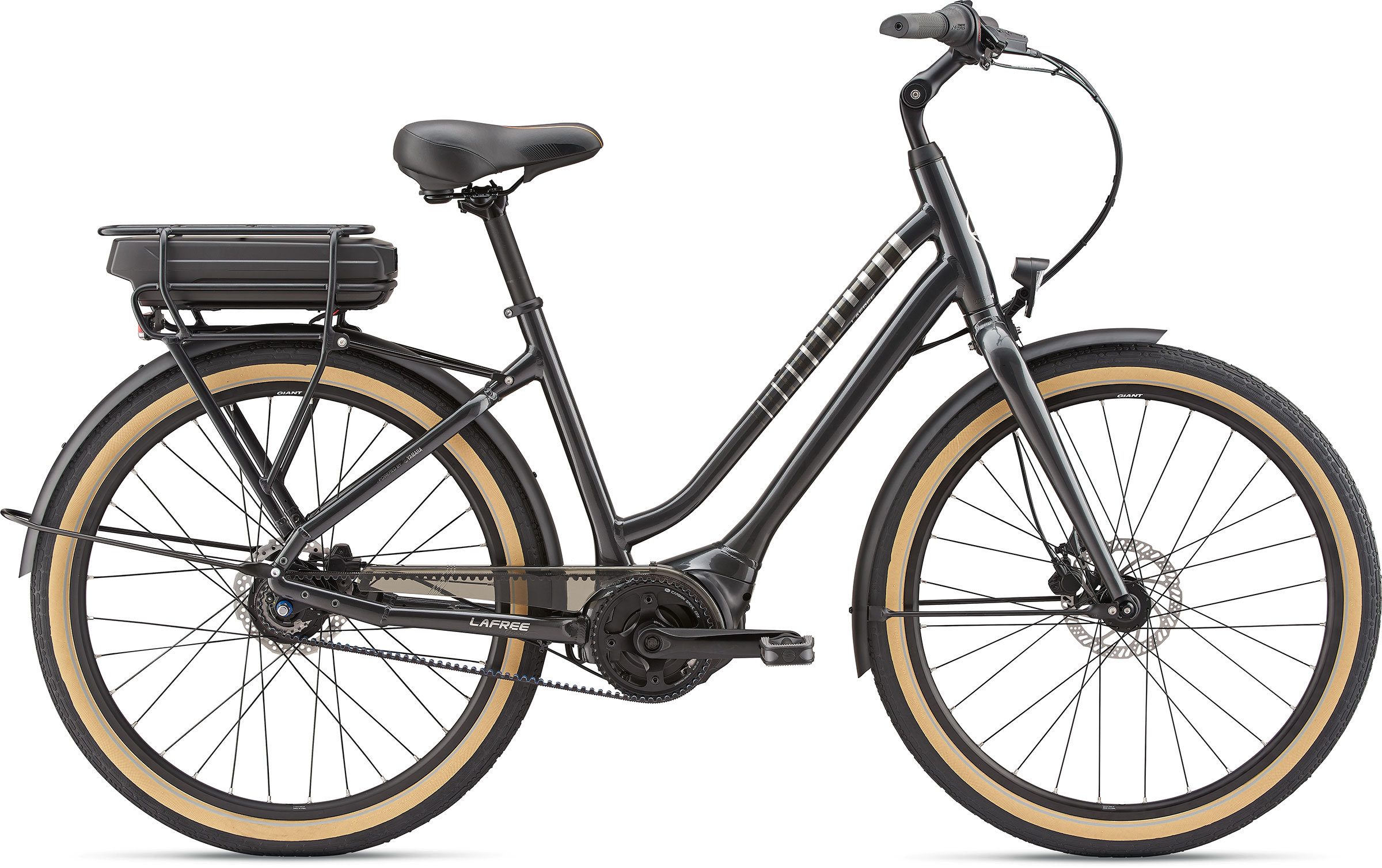
Giant’s LaFree range has long been one of the more sensible options in the step-through electric bike UK category, and the 2026 E+ 1 continues that tradition with some meaningful improvements. The Yamaha SyncDrive Sport motor used here is one of the better-regarded mid-drives in the industry — responsive, quiet, and with a natural torque delivery that copes particularly well with stop-start urban riding.
The geometry is upright and stable without feeling sluggish. Giant has also fitted hydraulic disc brakes rather than the mechanical discs you tend to find at this price point, and the difference in wet braking confidence is tangible rather than theoretical — something UK riders will appreciate across approximately nine months of the year. The integrated frame battery sits neatly within the downtube, improving both aesthetics and centre-of-gravity.
Where the LaFree distinguishes itself from a purely practical standpoint is in fit flexibility. It’s available across three frame sizes and the handlebar and seatpost offer a wide range of adjustment, which means you’re more likely to land on a position that works for your specific proportions. This might seem basic, but bikes that only come in one or two sizes effectively exclude a significant portion of the population from riding them comfortably.
It’s on the heavier side at around 27kg, which is worth noting. Giant’s service network in the UK is extensive, though, and for city and town riders who want genuinely good wet-weather braking and a motor that handles traffic-speed riding elegantly, the LaFree earns its place firmly on any shortlist.
Strengths- + Hydraulic disc brakes standard
- + Yamaha motor handles urban riding well
- + Good fit range across frame sizes
- + Integrated battery looks clean
Limitations- − Heavier than some rivals
- − Premium for urban-specific use case
Best for: City and town riders, particularly those who need reliable wet-weather stopping power and want a bike that fits a wide range of body types.
Best for Compact Storage
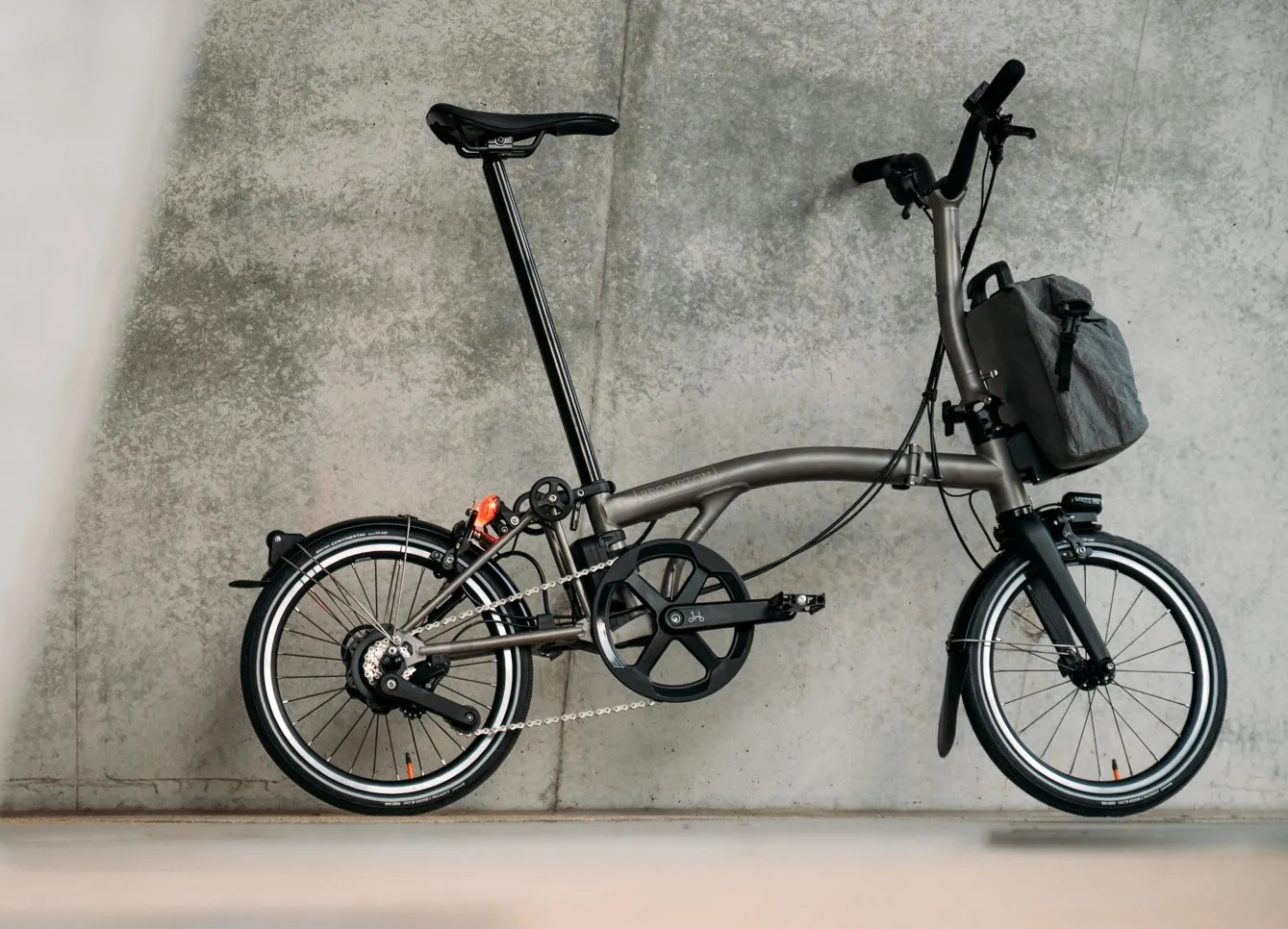
The Brompton is a category apart, and worth including precisely because storage and portability rank highly for many older riders. This is an electric folding bike built around Brompton’s iconic six-fold design — it collapses to roughly the size of a carry-on bag, weighs around 12.9kg (notably light for an e-bike), and fits into car boots, hallway cupboards, and small flats with equal ease.
The T Line designation refers to Brompton’s lightweight titanium-enhanced variant. The electric assist comes from a front hub motor and a compact battery that integrates into the front luggage block — a neat design decision that keeps weight low and the riding position unaffected. The range is modest (around 25–35 miles realistic), and the fold takes a few days of practice to execute efficiently. Neither of these is a dealbreaker for the right rider, but they’re worth naming honestly.
What the Brompton Electric T Line does exceptionally well is remove the barriers that prevent older adults from combining cycling with other transport. Carrying it onto a train, stowing it in a taxi, keeping it under a restaurant table while having lunch — these things are genuinely possible in a way they aren’t with full-size e-bikes. For older adults who live in flats, use public transport regularly, or travel frequently, this isn’t just a nice-to-have. It’s a fundamentally different kind of mobility.
Strengths- + Exceptional portability and storage
- + Lightest option on this list
- + Premium British engineering
- + Train/transport friendly
Limitations- − Most expensive here
- − Short range
- − Small wheels less stable at higher speeds
- − Fold technique takes learning
Best for: Urban-dwellers in flats, frequent travellers, and anyone who needs their e-bike to coexist with other transport. Not for those who want long-distance range.
Premium Choice
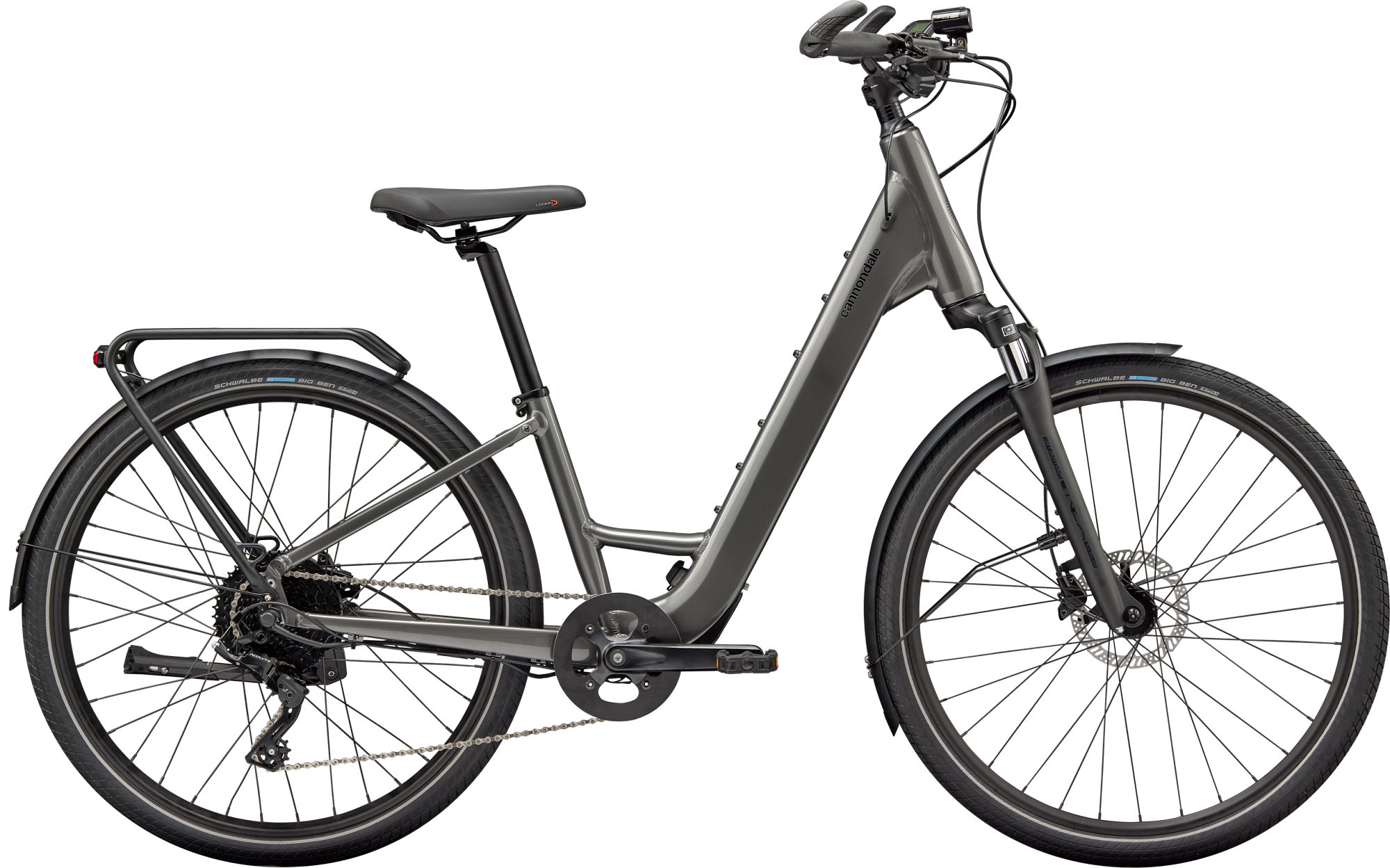
For riders who want the best available rather than the most practical, the Mavaro Neo SL 2 is a compelling argument. Cannondale has positioned this as a lightweight electric bike UK seniors at the premium end of the comfort touring segment, and the execution largely delivers on that ambition. The SmartSense system — automatic lighting that activates based on ambient conditions, and a radar unit that detects approaching vehicles from behind — brings a level of safety technology usually reserved for far more expensive machines.
The frame is SmartForm C1 aluminium, well-engineered and notably stiff for its weight. Combined with the Shimano EP8 mid-drive motor (one of the most refined mid-drives currently on the market), the result is a bike that disappears beneath you in a positive sense — you’re not wrestling with it or compensating for its weight, you’re simply riding. The 360Wh battery delivers a reliable 50–60 miles with mixed assistance use.
It’s expensive. At £3,400 it sits above most people’s considered budget for an e-bike, and for pure value it isn’t the right choice. But for older riders who are healthy enough for more active cycling, want a bike they’ll still enjoy in a decade, and value the safety features genuinely, the Mavaro makes a case for itself. The automatic rear-approach radar, in particular, is the kind of feature you don’t appreciate until you’re cycling on an A-road shoulder and a lorry approaches — at which point you appreciate it enormously.
Strengths- + SmartSense radar/auto-lighting
- + Shimano EP8 is class-leading
- + Excellent long-term durability
- + Refined, responsive handling
Limitations- − Significant cost
- − Overkill for short local rides
- − Requires confident riding ability
Best for: Active older riders who want a long-term investment and genuinely value advanced safety technology. A serious bike for serious leisure cycling.
Quick Comparison
| Model | Price | Weight | Motor | Range (realistic) | Frame |
|---|
| Raleigh Motus Grand Tour ST | ~£2,199 | ~26kg | Bosch Active Line+ | 50–60 mi | Step-through |
| Specialized Turbo Como SL 4.0 | ~£2,800 | ~16.5kg | SL 1.1 (Specialized) | 35–45 mi | Step-over / low |
| Dawes Kingpin E-Bike | ~£1,499 | ~24kg | Bafang hub | 40–50 mi | Step-through |
| Giant LaFree E+ 1 ST | ~£2,599 | ~27kg | Yamaha SyncDrive Sport | 45–60 mi | Step-through |
| Brompton Electric T Line | ~£3,095 | ~12.9kg | Front hub | 25–35 mi | Folding |
| Cannondale Mavaro Neo SL 2 | ~£3,400 | ~17kg | Shimano EP8 | 50–60 mi | Step-over |
On the Road
Safety and Real-World Riding — What the Spec Sheet Doesn’t Tell You
UK roads are not always kind to cyclists. Potholes, inconsistent road surfaces, unpredictable traffic behaviour, and the omnipresent dampness that affects braking distances — these are the real conditions in which your e-bike needs to perform. The controlled-conditions range tests that manufacturers use to generate their headline figures don’t account for any of this.
Confidence matters as much as any technical specification. Many older adults returning to cycling after a long gap — or riding an e-bike for the first time — underestimate how quickly confidence comes back and how significantly the riding experience improves after the first three or four outings. The first ride on a new e-bike in an unfamiliar environment is rarely the best indicator of long-term enjoyment. Empty car parks, quiet residential roads, and dedicated cycle paths are genuinely useful places to spend a few hours reacquainting yourself with riding before moving onto busier routes.
Wet braking deserves separate mention. Rim brakes — still found on some lower-cost e-bikes — lose significant stopping power in the rain. Disc brakes, either hydraulic or mechanical, perform far more consistently in wet conditions. Given that UK riding involves rain in quantity, this isn’t a minor distinction. Any e-bike intended for regular use should, in an ideal world, have disc brakes fitted.
A well-fitted helmet, high-visibility clothing, and working lights — front and rear — remain the baseline of sensible UK cycling. Several of the bikes listed above come with lights pre-fitted; for those that don’t, budget an additional £40–60 for a quality set. Gloves are worth considering too, not just for warmth but because vibration damping on long rides reduces hand fatigue considerably.
On falls: One often-unspoken concern among older riders considering e-bikes is the consequence of a fall. This is worth taking seriously rather than dismissing. E-bikes are heavier than conventional bikes, and at low speeds a topple is a genuine risk, particularly during dismounting or navigating tight spaces. Practising low-speed manoeuvring, always dismounting from the correct side, and being willing to walk the bike through genuinely crowded areas are all sensible adaptations — not signs of limitation.
The Rules
UK E-Bike Law: What You Need to Know
Electrically Assisted Pedal Cycles — EAPCs in official terminology — are treated as conventional bicycles under UK law, provided they meet certain criteria. The motor must not exceed 250 watts continuous rated output, assistance must cut out at 15.5mph (25km/h), and the motor can only operate when the rider is actively pedalling. Bikes meeting these criteria require no licence, no registration, and no insurance — though insurance is worth considering anyway, primarily for theft cover.
You must be at least 14 years old to ride one. On everything else — road use, cycle path access, speed limits — an EAPC is treated identically to a non-electric bicycle. This means they can be ridden on cycle paths and shared-use paths where cycling is permitted, and they’re subject to the same rules of the road as conventional bikes.
Higher-specification e-bikes with throttles that operate without pedalling, or that provide assistance above 15.5mph, fall into different legal categories (moped or motorcycle classification) and require registration, insurance, and a valid licence. Most bikes sold specifically as senior or comfort e-bikes in the UK market are straightforward EAPCs and comply with the standard rules. It’s worth confirming this when purchasing — reputable retailers will confirm EAPC compliance as standard.
Closing Thoughts
Which Bike, Then?
The honest answer is that it depends more on how and where you’ll use it than on any objective quality hierarchy. The Raleigh Motus is the safest recommendation for most people — it’s from a trusted UK brand, uses excellent Bosch assist technology, arrives fully equipped, and has the kind of wide dealer network that makes servicing genuinely straightforward. If budget is less of a constraint and weight matters, the Specialized Como SL is a significantly nicer bike to ride and manage.
For city dwellers or anyone whose primary constraint is storage, the Brompton Electric T Line occupies a category of its own and does what it does with a level of engineering quality that justifies the price. It just won’t suit everyone, and the limited range is a real limitation for longer rides.
What I’d encourage anyone to do before committing is to test-ride at least two bikes from a physical shop rather than buying online sight-unseen. E-bike geometry and ride feel vary considerably, and the difference between a bike that feels right and one that merely functions adequately is large enough to affect whether you actually use the thing. Most independent bike shops in the UK offer demo rides; the larger chains often do too. Use them.
The broader point is worth reiterating: the best electric bike for older adults in the UK is ultimately the one that gets ridden. Confidence, comfort, and a riding experience that meets you where you are rather than demanding adjustment — these are the qualities that translate into consistent use, and consistent use is what delivers the health, social, and practical benefits that make e-bikes worth talking about in the first place.
Common Questions
Frequently Asked Questions
Do I need a licence to ride an electric bike in the UK?
No — as long as the bike qualifies as an EAPC (Electrically Assisted Pedal Cycle), which the vast majority of bikes sold specifically for road use do. This means a motor rated at no more than 250 watts, assistance capped at 15.5mph, and no powered movement without pedalling. You don’t need insurance either, although contents or cycling-specific insurance for theft cover is worth considering.
What’s a realistic battery range for everyday UK riding?
Manufacturers quote headline figures that assume favourable conditions — flat roads, moderate temperatures, lower assistance settings, lighter riders. In real UK use, assume roughly 60–70% of the advertised range. A bike claiming 70 miles will typically deliver 40–50 in mixed conditions. For most older riders doing local leisure trips and errands, that’s entirely adequate. If you regularly ride more than 30 miles in a single session, prioritise range more heavily.
How heavy are e-bikes, and does it matter?
Most full-size e-bikes weigh between 22–28kg. This doesn’t affect the riding experience much — the motor compensates — but it matters significantly when lifting, transporting, or manoeuvring the bike off the road. Lightweight models (16–19kg) exist at a premium and are worth the investment if storage or car transport is a regular requirement. The Specialized Como SL and Brompton T Line are the best lightweight options on this list.
Should I get a step-through frame?
If you have any hip, knee, or balance concerns, yes — and honestly, for most older riders, a step-through frame is the sensible default regardless. The practical ease of mounting and dismounting reduces the low-speed topple risk that catches out many riders returning to cycling. Modern step-through designs for adults are structurally robust and carry no performance penalty on the road.
Can I ride an e-bike if I have knee or hip problems?
In many cases, yes — and it’s one of the reasons e-bikes have become popular among older adults with joint conditions. The pedal-assist reduces the load required on each stroke, making cycling accessible for people who would find conventional cycling painful. That said, if you have a specific medical condition, it’s worth discussing with your GP before starting. Bike fit — saddle height, handlebar position — matters considerably for joint comfort and a specialist bike shop can help you get this right.
What’s the best way to try before buying?
Visit a physical bike shop rather than buying online first. Most independent stores and many larger cycling retailers offer demo rides, and the difference between bikes that look similar on a spec sheet can be dramatic when you actually ride them. Take at least 15 minutes per bike — enough to get comfortable with the motor response and riding position. If you’re buying for someone else, bring them along. Fit and confidence are personal, and a bike that feels right to you may not feel right to them.

 By
By 