 By
By Generative AI creates. Agentic AI executes. Businesses are waking up to a fundamental shift: from content generation to autonomous action. Here’s why understanding Generative AI vs Agentic AI decides who leads the next automation wave.
Ask ten business leaders what they mean by “AI,” and nine will describe something that writes emails, generates images, or summarizes documents. That’s Generative AI. It’s impressive. But a quieter shift is already underway—one that doesn’t just create content but acts on it. Meet Agentic AI. Instead of waiting for your next prompt, it sets its own goals, makes decisions, and executes multi-step tasks. Think of the difference between a calculator that solves one equation and a finance intern who reconciles your entire ledger, flags discrepancies, and emails the team.
This distinction is critical right now. Most companies have experimented with ChatGPT, built internal tools, but when conversations turn to automation that transforms workflows—not just assists—Agentic AI enters the room. Let’s break down each technology, real business applications, and where the puck is going.
What Is Generative AI?
Definition
Generative AI refers to models that create new content—text, images, code, audio—based on patterns from existing data. Unlike predictive AI, generative models produce novel outputs each time you prompt them.
How Generative AI Works
At its core, Generative AI learns probability distributions. Large language models (LLMs) like GPT-4 process billions of sentences and predict which word follows another. Image generators like DALL·E learn to reverse noise into coherent pictures. They don’t “know” facts; they generate plausible continuations.
Popular Examples
ChatGPT, Claude, Gemini for text; DALL·E, Midjourney for visuals; GitHub Copilot for code; ElevenLabs for voice synthesis.
Common Use Cases
Drafting emails, summarizing reports, generating product descriptions, code completion, and customer support response drafts. The common thread: output stops at creation. A human must still send, update, or trigger next steps.
What Is Agentic AI?
Definition
Agentic AI describes autonomous systems that pursue goals, make decisions, take actions, and adapt based on feedback—with minimal human intervention. An AI agent doesn’t just answer; it figures out what needs to be done, executes steps, uses tools, and loops until the objective is met.
How Agentic AI Works
Most modern agents operate on a perceive → reason → act → observe → re-plan loop. Using an underlying LLM as a reasoning engine, they break high-level goals into sub-tasks, call external APIs, query databases, and adjust strategies when things fail. Memory (short and long term) allows them to improve over time.
Examples of Agentic AI Systems
AutoGPT, BabyAGI (experimental research agents), Cognition’s Devin (AI software engineer), and custom enterprise agents that combine reasoning with robotic process automation (RPA).
Common Use Cases
Travel booking end-to-end, vendor invoice reconciliation, lead research (scraping, emailing, tracking replies), IT incident response, and supply chain exception handling. Each use case requires multi-step orchestration across systems.
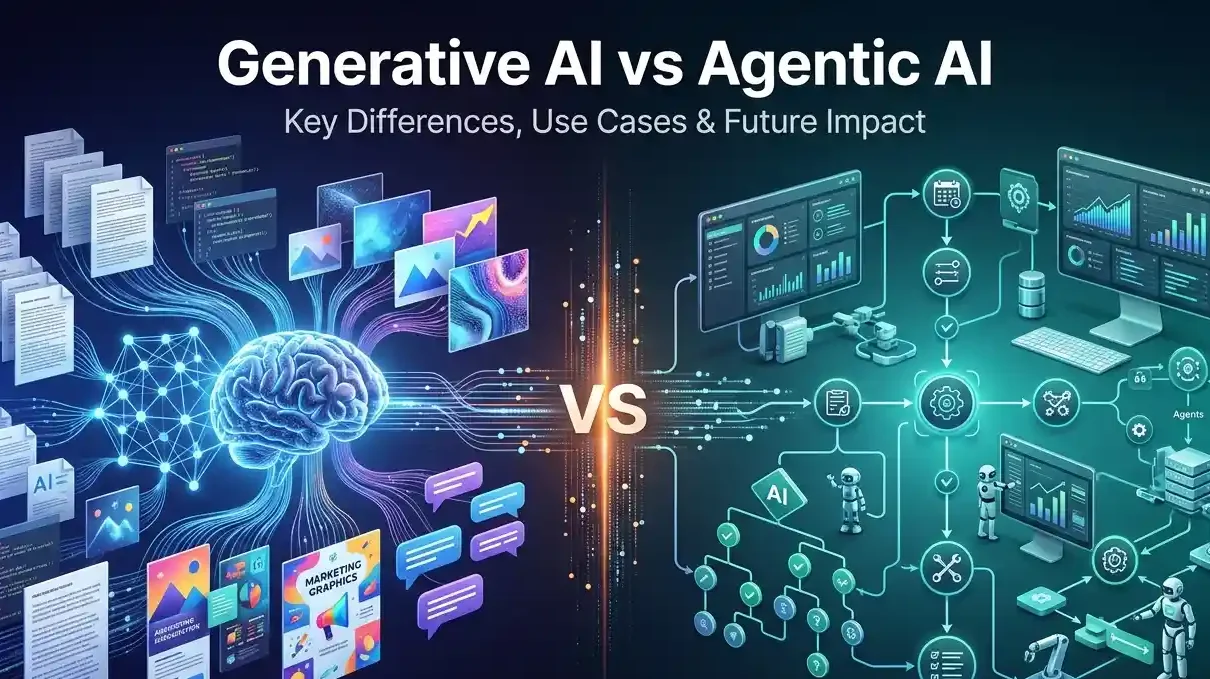
Generative AI vs Agentic AI: Key Differences
| Dimension | Generative AI | Agentic AI |
|---|---|---|
| Purpose | Create content or output based on a prompt | Achieve a goal through multi-step actions |
| Autonomy | Zero autonomy – needs prompt every time | Moderate to high – works until goal achieved |
| Decision-making | Statistical prediction (next word/pixel) | Goal-directed planning with feedback loops |
| Planning capability | None – no inherent sense of sequential steps | Core feature – breaks goals into tasks |
| Tool usage | No native ability to call external tools | Built to use APIs, browsers, code executors |
| Human involvement | Every output needs human prompt & review | Human sets goal; agent acts, reports, asks for help |
| Scalability | High – generate millions of images | Moderate – each agent consumes compute per task |
| Business impact | Reduces content creation time | Automates entire workflows & processes |
How Agentic AI Builds on Generative AI
Here’s a nuance many miss: most Agentic AI systems cannot exist without Generative AI. The reasoning engine at their core is almost always an LLM. Generative AI provides the “brain” (understanding language, breaking down problems, deciding which tool to use). Agentic AI wraps that brain with “hands”—the ability to execute actions, remember context, and loop until completion.
📌 Practical business example: customer returns
Generative AI assistant: Drafts an apology email and replacement instructions. A human must verify inventory, issue return label, and send the email. Agentic AI system: Reads the email, queries order system, checks warehouse stock, creates replacement order, generates return label, emails customer, logs incident in CRM, and reports completion—all without human touch beyond goal setting.
Real-World Business Applications
Marketing
Gen AI: draft blog posts, social copy. Agentic: manages A/B tests, adjusts ad spend across platforms, and optimizes campaigns toward signup goals autonomously.
Customer Support
Gen AI: FAQ chatbots. Agentic: resets passwords, processes refunds, cancels subscriptions. One logistics firm reduced tier-2 tickets by 40%.
Sales
Agentic AI researches companies, enriches CRM, schedules meetings, and sends follow-ups. SDRs gain 3–5x more touchpoints per day.
Software Dev
Gen AI: code suggestions. Agentic: agents (like Devin) resolve GitHub issues, write tests, run builds, open PRs autonomously.
Finance
Agentic AI monitors transaction feeds, flags fraud, pulls supporting docs, drafts SAR reports, cuts investigation time from hours to minutes.
Operations
Orchestrates multi-system workflows: provisioning cloud resources, reconciling inventory, sending purchase orders—RPA with reasoning.
Benefits and Challenges of Generative AI
Advantages: Drastically reduces content creation time, low technical barrier, mature ecosystem, predictable costs. Limitations: No action capability, hallucinations, no memory across sessions, passive. Risks: Over-reliance, data leakage via prompts, copyright ambiguity.
Benefits and Challenges of Agentic AI
Advantages: Automates end-to-end workflows, operates asynchronously, uses any API, learns from execution feedback. Limitations: Higher complexity, compute costs can escalate, error amplification, still experimental. Governance & security: Requires least-privilege access, extensive logging, human-in-the-loop for critical actions. Accountability is the frontier challenge.
Future Impact of AI: Multi-Agent Systems & Autonomous Digital Workers
Over the next five years, expect three major shifts: multi-agent systems (specialized agents collaborate), autonomous digital workers with roles and permissions, and enterprise orchestration layers for agent lifecycle management. The future isn’t full autonomy—it’s hybrid teams where AI escalates uncertainty, explains reasoning, and learns from corrections. Small, specialized models for agentic tasks will also drive down costs.
Which One Is Right for Your Business?
- Stick with Generative AI if your primary need is content creation, summarization, and you have humans to execute next steps.
- Pilot Agentic AI for repetitive, multi-step workflows across CRMs, spreadsheets, and email—especially if you have strong API coverage.
- Plan for both: Generative AI everywhere for assistive tasks, Agentic AI for high-ROI workflow automation. They complement, not compete.
Generative AI vs Agentic AI: The Action Gap
The core difference between Generative AI vs Agentic AI is action. Generative AI creates. Agentic AI executes. One answers questions. The other completes missions. For business leaders, the smartest strategies use Generative AI to augment creativity while deploying Agentic AI to automate manual coordination. They will coexist, converge, and define the next decade of enterprise intelligence.
Follow UKTechWire for more tips!
Frequently Asked Questions
Generative AI produces content in response to a prompt, while Agentic AI plans sequences of actions, uses tools, and works autonomously toward objectives. One creates; one executes.
No, standard ChatGPT is purely generative. However, when combined with function calling, plugins, or agent frameworks, the same model becomes part of an agentic system. The architecture matters.
Early symbolic agents could, but modern flexible Agentic AI that handles natural language and novel situations relies on LLMs. Practically, Agentic AI needs Generative AI as the reasoning core.
True workflow automation across multiple software systems, reduced manual handoffs, asynchronous operation, and scaling digital labor without hiring. For example, invoice reconciliation can be reduced from hours to minutes.
No. Agentic AI builds on generative models. You’ll use Generative AI for creativity and summarization, while agentic systems handle automation. They serve different purposes and coexist.
Finance (reconciliation, fraud detection), logistics (order tracking, vendor coordination), healthcare (claims processing), legal (document review workflows), and software development are among the industries that stand to benefit the most. Any domain with multi-step, rule-guided workflows across systems is a strong candidate.

Jalees Ur Rehman is an SEO professional with 13+ years of experience in SEO and Digital Marketing. He helps businesses grow organic traffic and conversions through data-driven digital marketing strategies and practical execution.