
 By
By 2026 is shaping up to be a spectacular year for space enthusiasts. Honestly, we haven’t had a lineup quite like this in over a decade. Between NASA’s historic return to the Moon with the Artemis program and a series of dazzling celestial events visible right from your back garden in the UK, there’s plenty to get excited about.
Whether you’re a seasoned astronomer with a high-end telescope or just someone who likes looking up at the night sky with a cuppa in hand, this guide covers everything you need to know. We’ve broken down the NASA Space Calendar 2026, highlighting mission milestones and stargazing opportunities specifically for the United Kingdom.
Grab your diary, and let’s get planning.
Quick Answer Section
What are the major NASA space events in 2026?
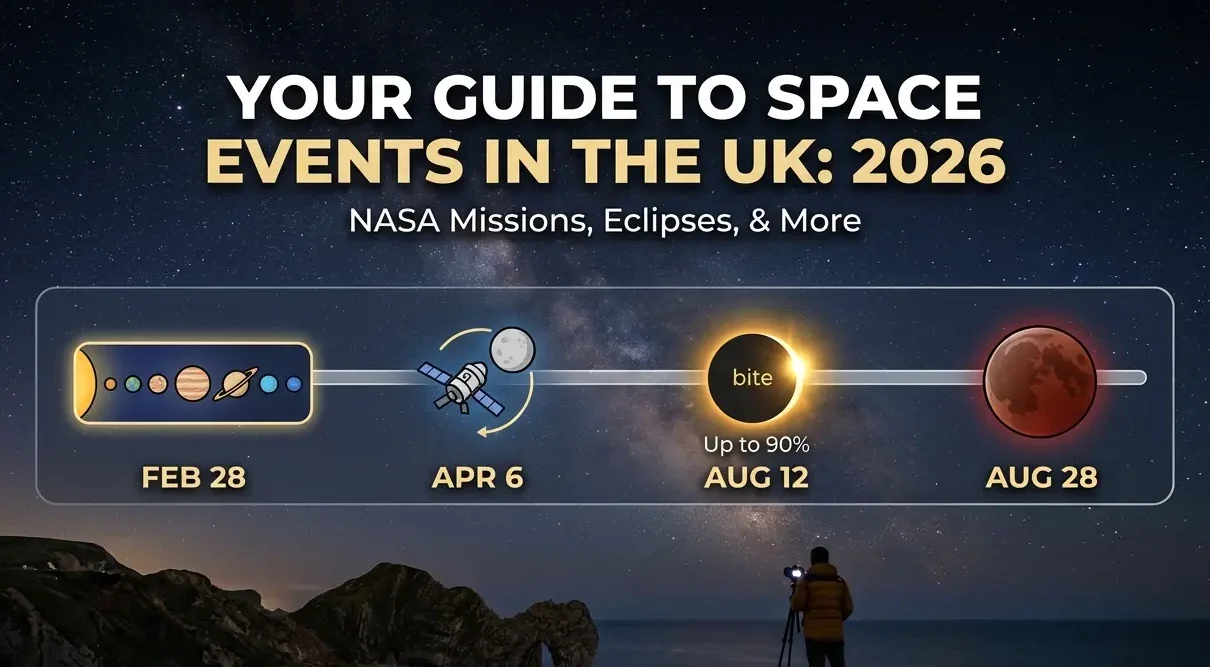
- Artemis II Lunar Flyby (April 6): NASA’s first crewed Moon mission since 1972, carrying four astronauts around the far side of the Moon.
- Partial Solar Eclipse (August 12): Up to 90% of the Sun will be obscured by the Moon—the last significant solar eclipse visible from the UK until 2090.
- Partial Lunar Eclipse (August 28): Over 90% of the Moon will turn a deep reddish-brown, visible across the UK.
- Planetary Alignments: A stunning six-planet lineup on February 28, featuring Jupiter, Venus, and Mars.
- Multiple Supermoons: Including the “Blue Moon” on May 31 and the “Cold Moon” on December 23.
NASA Space Missions 2026: Back to the Moon
The biggest story of 2026 isn’t happening in a lab—it’s happening 250,000 miles away. NASA’s Artemis program is finally kicking into high gear, and the UK will have front-row seats (via livestream) for the action.
Artemis II: The Lunar Flyby
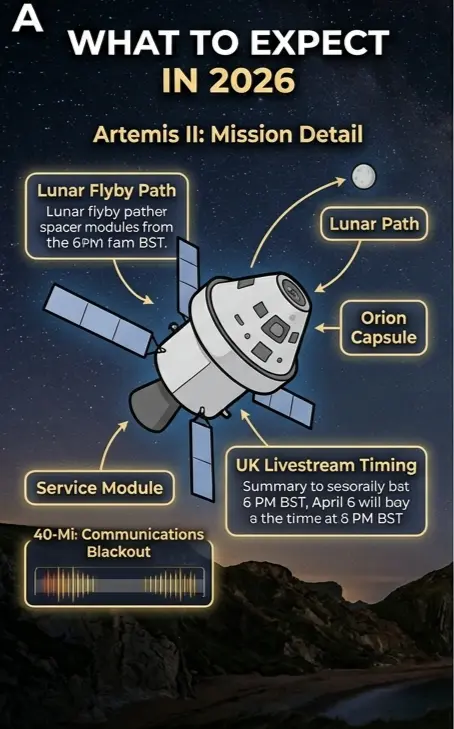
On April 1, 2026, the Orion spacecraft launched carrying four astronauts: Reid Wiseman, Victor Glover, Christina Koch, and Jeremy Hansen. However, the main event for viewers is the historic lunar flyby on April 6.
How to watch in the UK: NASA’s live coverage begins at 6:00 PM BST on April 6. The crew will fly closer to the Moon than anyone has in over 50 years. You can catch the stream on Netflix, NASA+, or YouTube. There will be a 40-minute communications blackout as Orion passes the far side of the Moon—a nail-biting moment for mission control.
Uncrewed Landers and Prep for Mars
While the crew is looping around the Moon, NASA is also sending robotic landers to the lunar surface. Missions from Astrobotic (July) and Blue Origin are scheduled to test technologies for future landings. These steps are crucial because NASA is eyeing a human landing on Mars in the 2030s.
For more on the tech driving these missions, check out the latest future space innovations on UK Tech Wire.
Astronomical Events Visible in the UK (Beyond NASA)
You don’t need a rocket ship to enjoy 2026. The regular old sky above the UK is putting on a show of its own. Here are the unmissable astronomical events UK residents should save the date for.
1. The Deep Partial Solar Eclipse (August 12)
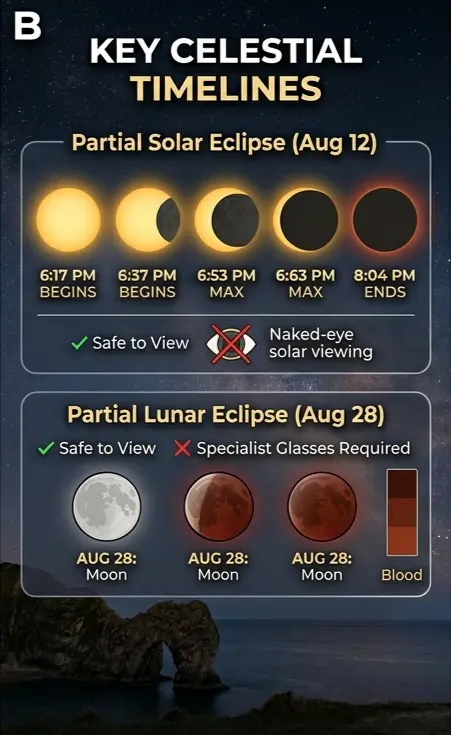
The “2090” Eclipse. If you miss this, you’ll be waiting a lifetime. On August 12, starting at 6:17 PM BST, the Moon will take a massive “bite” out of the Sun. In northern Scotland, up to 90% of the Sun will be covered.
Safety First: Never look directly at the Sun. You need certified solar eclipse glasses. Seriously, don’t risk it.
2. The “Blood Moon” Partial Lunar Eclipse (August 28)
Just two weeks after the solar event, the Moon gives us an encore. In the early morning of August 28 (from 2:34 AM to 5:52 AM), the Earth’s shadow will cover about 93% of the lunar surface. Unlike solar eclipses, this is safe to view with the naked eye—though binoculars will make the rusty red colour pop.
3. The Big Planetary Line-Up (February 28)
Mark the calendar for a “planet parade.” On February 28, six planets will arc across the sky. Jupiter, Saturn, Venus, and Mercury will be visible without any equipment. Uranus and Neptune are technically there, too, but you’ll need a telescope to spot those.
Month-by-Month Space Calendar (UK Time)
Here is your printable cheat sheet for the space missions timeline in 2026.
| Month | Date | Event | Visibility in the UK |
|---|---|---|---|
| February | 28th | 6-Planet Alignment (Jupiter, Venus, Mars, Saturn, Mercury, Uranus) | Excellent (Evening sky) |
| April | 6th | Artemis II Lunar Flyby | Livestream only (6:00 PM BST) |
| April | 22nd | Lyrids Meteor Shower | Good (Moonless sky) |
| May | 31st | “Blue Moon” (Second Full Moon in a month) | Great (All night) |
| August | 12th | Partial Solar Eclipse (Deep Partial) | High risk of clouds, but high reward |
| August | 12-13th | Perseids Meteor Shower | Fair (Competes with Moonlight) |
| August | 28th | Partial Lunar Eclipse | Great (Early morning) |
| November | 17th | Leonids Meteor Shower | Excellent (New Moon provides dark skies) |
| December | 14th | Geminids Meteor Shower | Moderate |
| December | 23rd | “Cold Moon” Supermoon | Brilliant (Biggest of the year) |
How to Watch Space Events in the UK
Okay, you’ve got the dates. But how do you actually see them? Light pollution is the enemy, but you don’t have to drive to the Scottish Highlands (though that helps).
1. Find a Dark Sky Spot
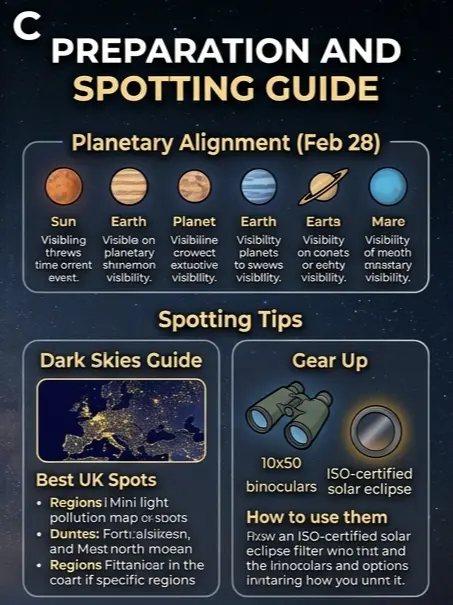
You don’t need to go remote, but get away from streetlights. Checking a light pollution map is a game-changer. Northern Ireland boasts some of the darkest skies, especially around the Sperrin Mountains. Parks, beaches, or even just the end of your garden facing away from the house works wonders.
2. Gear Up (Cheaply)
– For the Solar Eclipse: You must have ISO-certified eclipse glasses. Standard sunglasses won’t cut it.
– For Planets/Moon: A cheap pair of 10×50 binoculars will show you Jupiter’s moons and the craters on our Moon better than any expensive telescope you haven’t learned to use yet.
– For Meteors: Zero gear required! Just lie back, let your eyes adjust for 20 minutes, and look up.
3. Websites & Apps
Keep an eye on the BBC Weather forecast for cloud cover. Apps like Stellarium or Sky Tonight use your phone’s GPS to show you exactly where to point your eyes.
Stay ahead of the tech curve with the latest space technology updates from UK Tech Wire.
Importance of NASA’s 2026 Calendar
Why does this year matter more than others? Because 2026 is the bridge between the past and the future.
For the first time since 1972, humans are venturing into deep space—not just low Earth orbit. The Artemis II mission isn’t just a tourist trip around the Moon; it’s the final safety check before Artemis III lands on the lunar surface in 2027.
Moreover, the astronomical events UK residents will see—like the solar eclipse—are happening because of precise cosmic mechanics. But the NASA missions add a layer of relevance. We aren’t just watching the Moon; we are going back to it. This is the training ground for AI in space exploration and the eventual journey to Mars.
If you want to feel optimistic about science and human ingenuity, just follow the NASA launches 2026. It’s going to be emotional.
For more UK tech news and future space innovations, bookmark UK Tech Wire.
FAQs
Q1: When can I see the next solar eclipse in the UK?
The next deep partial solar eclipse visible from the UK is on August 12, 2026, starting at 6:17 PM BST. Up to 90% of the Sun will be covered. The next total eclipse in the UK isn’t until September 2090.
Q2: Is the Artemis II Moon mission visible from the UK?
No, the spacecraft is too far and small to see with the naked eye. However, NASA will livestream the entire lunar flyby on Netflix and YouTube starting at 6:00 PM BST on April 6, 2026.
Q3: What is the best meteor shower of 2026 for UK viewers?
The Leonids in November offer the best conditions due to a New Moon providing dark skies. The Perseids in August are active but face light interference from the Moon this year.
Q4: How many supermoons will there be in 2026?
There will be three supermoons in 2026: the Wolf Moon in January, the Beaver Moon in November, and the Cold Moon in December. The December supermoon will be the largest and brightest.
Q5: What is the “Blue Moon” in May 2026?
A “Blue Moon” is the name given to the second Full Moon occurring within a single calendar month. It happens on May 31, 2026. Despite the name, the Moon won’t actually turn blue.
Q6: Do I need special glasses for the August lunar eclipse?
No. Unlike a solar eclipse, a lunar eclipse is completely safe to view with the naked eye, binoculars, or a telescope. Just wrap up warm and find a clear eastern horizon.
Conclusion
2026 is a “do not miss” year for anyone interested in space. From the historic NASA Space Calendar 2026 featuring the return of human-rated spacecraft to the Moon, to the stunning astronomical events viewable from our own back gardens, the universe is inviting us to look up.
The partial solar eclipse in August might be the single rarest event you’ll see this decade—so book the day off work now.
What are you most excited to see? Whether it’s the Artemis astronauts or the shooting stars, let us know in the comments below. And don’t forget to check back on UK Tech Wire for live weather updates as these dates approach.
Clear skies!

Jalees Ur Rehman is an SEO professional with 13+ years of experience in SEO and Digital Marketing. He helps businesses grow organic traffic and conversions through data-driven digital marketing strategies and practical execution.
7 Comments