
 By
By Quick Answer: For cinematic realism, Google Flow and Sora lead the pack. Runway is the strongest choice for hands-on editing and production workflows. Beginners will find Runway most accessible, while filmmakers and serious creators should explore Google Flow or Sora for higher-fidelity output. The “best” tool depends entirely on your use case.
AI video generation has moved from novelty to necessity at a remarkable pace. What once required a full production team, expensive equipment, and weeks of post-production can now be approximated in minutes with a text prompt. Google Flow, OpenAI’s Sora, and Runway are three of the most talked-about tools in this space but they serve different purposes, audiences, and workflows.
This comparison breaks down exactly what each tool does, where it excels, and who it’s best suited for, so you can make an informed decision rather than an expensive guess.
What Is Google Flow AI?
Google Flow is an AI-powered video generation tool developed by Google DeepMind. It’s built on top of Veo, Google’s advanced video generation model, and is designed to support longer-form, cinematic-quality video creation. Flow allows users to generate videos from text prompts and images, with a particular emphasis on maintaining visual consistency across shots — a critical feature for storytelling.
Key features of Google Flow:
- Built on the Veo 2 model (with Veo 3 integration being rolled out)
- Supports text-to-video and image-to-video generation
- Designed for multi-shot, narrative-style video creation
- Produces high-resolution output with strong temporal coherence
- Currently available via Google Labs in limited access
Google Flow is positioned as a tool for filmmakers and professional creators who need more than a clip generator. Its scene-building capabilities make it one of the most ambitious AI video platforms currently available.
What Is OpenAI Sora?
Sora is OpenAI’s text-to-video model, first unveiled in early 2024 and made available to ChatGPT subscribers later that year. It generates high-definition video clips from natural language descriptions, and its outputs quickly became a benchmark for realism in AI video.
What sets Sora apart:
- Generates videos up to 20 seconds in length
- Produces remarkably realistic motion, lighting, and physics simulation
- Supports video generation from text, images, and existing video clips
- Integrated with ChatGPT Plus and Pro plans
- Offers a “storyboard” feature for more structured scene creation
Sora’s strength lies in the quality of individual clips. The model handles complex scenes — crowds, weather, architectural detail — with impressive consistency. However, it has limited built-in editing tools, meaning it functions more as a generation engine than a full production suite.
What Is Runway AI?
Runway is one of the longest-standing AI video platforms and has built a loyal following among creators, editors, and marketers. Unlike Sora or Google Flow, Runway combines AI generation with a robust set of editing tools, making it feel closer to a traditional video editing platform with AI capabilities layered in.
Runway’s core capabilities:
- Gen-3 Alpha model for high-quality text-to-video generation
- Frame interpolation, inpainting, and background removal
- Multi-modal inputs: text, image, and video-to-video
- Built-in timeline editor and post-production tools
- Available via subscription, with a free tier for new users
Runway’s approachability is a significant differentiator. It doesn’t require technical expertise, and its interface is familiar to anyone who has used a basic video editor. That accessibility, combined with its expanding AI feature set, makes it the go-to for content creators and marketers.
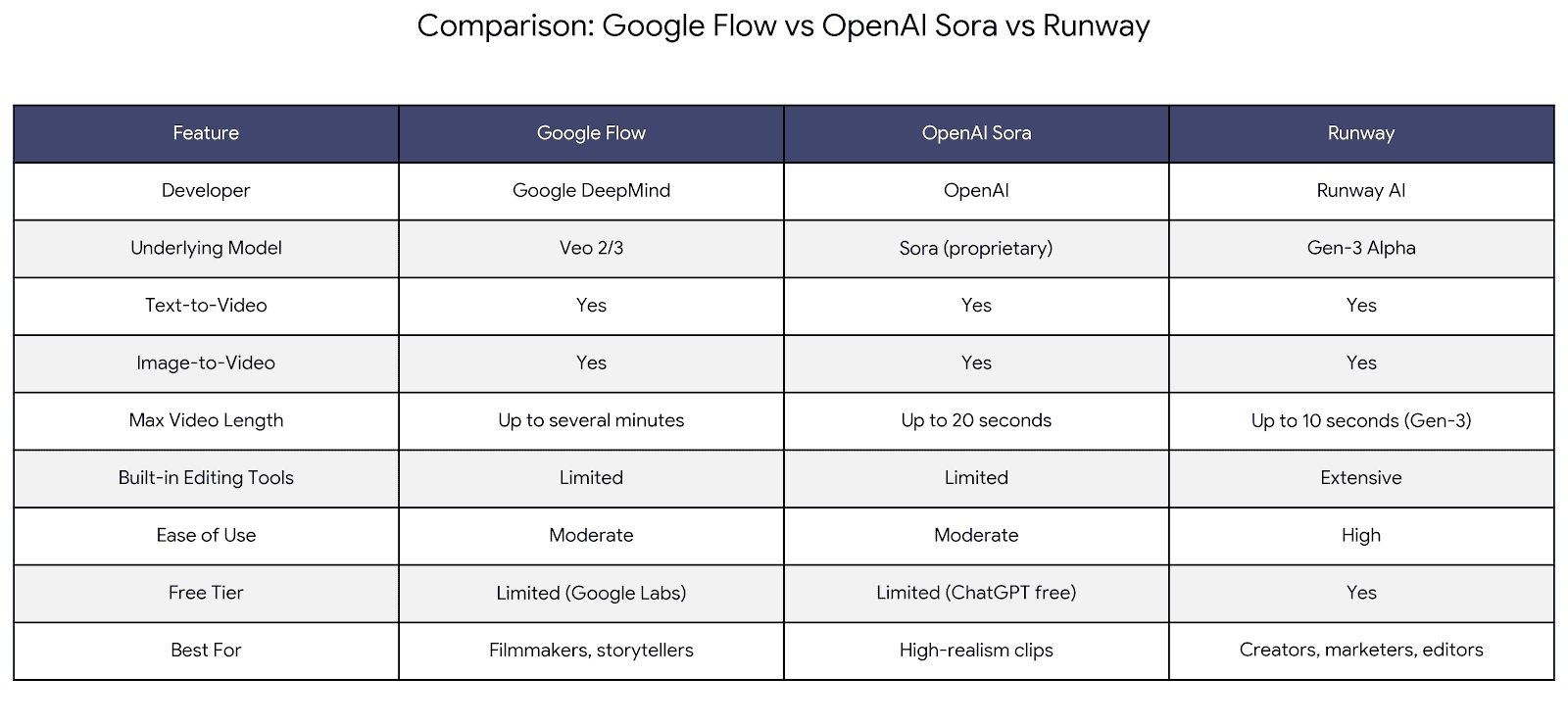
Feature Comparison: Google Flow vs Sora vs Runway
Google Flow vs Sora vs Runway: Key Differences
Video Quality and Realism
Sora and Google Flow currently produce the most photorealistic outputs. Both tools handle lighting, motion blur, and environmental detail at a level that Runway’s Gen-3 model doesn’t consistently match. That said, Runway has made significant strides with recent updates and continues to close the gap.
Creative Control
Runway wins here. Its editing suite gives users far more control over the final output, allowing for frame-level adjustments that neither Sora nor Google Flow currently support natively. For creators who want to refine and iterate, Runway’s workflow is considerably more flexible.
Accessibility
Runway is the easiest to access and use. It has a free tier, a polished interface, and extensive tutorials. Sora is available to ChatGPT Plus and Pro subscribers, making it reasonably accessible but not free. Google Flow remains in limited access through Google Labs, which restricts its availability significantly.
Production Workflow
Google Flow is the only tool explicitly designed for multi-shot narrative video — meaning it’s built with storytelling in mind, not just clip generation. Sora can produce individual clips of exceptional quality, but stitching them into a coherent production requires external tools. Runway bridges generation and editing, making end-to-end production more manageable within a single platform.
Which AI Video Generator Is Best for You?
Filmmakers and narrative creators should keep a close eye on Google Flow. Its multi-shot capabilities and focus on visual consistency across scenes make it the most promising tool for long-form or story-driven projects. Access is limited for now, but it’s the most forward-looking option for cinematic work.
Marketers will find Runway the most practical choice. Quick turnaround, editing tools, and a variety of templates make it well-suited to producing polished short-form content for social media and advertising campaigns.
Content creators — YouTubers, social media producers, and independent video makers — benefit most from Runway’s balance of quality and control. The free tier also reduces the barrier to experimentation.
Beginners should start with Runway. The interface is intuitive, the learning curve is gentle, and the free plan offers enough functionality to get a genuine feel for AI video generation without a financial commitment.
Limitations of AI Video Generators
Despite the impressive outputs, all three tools have real constraints worth acknowledging.
- Video length: Sora caps out at 20 seconds; Runway’s Gen-3 clips are typically under 10 seconds. Neither is a substitute for long-form video production yet.
- Rendering time: High-quality outputs can take several minutes to generate, which limits rapid iteration.
- Consistency: Maintaining the same character’s appearance across multiple clips remains a challenge across all platforms.
- Prompt sensitivity: Subtle changes in phrasing can produce dramatically different results, requiring patience and experimentation.
- Access restrictions: Google Flow’s limited availability makes it impractical for many users right now.
Understanding these limitations upfront saves frustration and helps set realistic expectations for what AI video tools can currently deliver.
The Future of AI Video Creation
The trajectory is clear. Video generation models are improving in quality, length, and controllability at a rapid pace. Google’s investment in Veo, OpenAI’s continued development of Sora, and Runway’s expanding toolset all suggest that the gap between AI-generated and traditionally produced video will continue to narrow.
Multi-shot coherence, real-time generation, and deeper integration with editing pipelines are likely to be the next major breakthroughs. For creators, the practical implication is that the tools available in 12 months will be substantially more capable than what exists today — making it worth investing time now to understand the fundamentals.
So, Which AI Video Generator Should You Choose?
There’s no single winner. Google Flow is the most promising for cinematic storytelling but remains largely inaccessible. Sora delivers the most consistent realism for individual clips but lacks editing depth. Runway is the most complete, accessible, and immediately practical tool for the widest range of users.
Start with Runway if you want results today. Watch Google Flow closely if you’re building for tomorrow.
Frequently Asked Questions
What is Google Flow AI?
Google Flow is an AI video generation tool developed by Google DeepMind, built on the Veo model. It is designed for cinematic, multi-shot video creation using text and image prompts, and is currently available in limited access through Google Labs.
Is Sora better than Runway?
Sora produces more photorealistic clips, but Runway offers significantly more editing tools and is easier to access. Sora is better for raw video quality; Runway is better for end-to-end production and practical creative workflows.
Which AI video generator is best for beginners?
Runway is the best option for beginners. It has a free tier, an intuitive interface, and extensive support resources, making it the most accessible AI video tool currently available.
Is Google Flow available to the public?
Google Flow is available in limited access through Google Labs and is not yet widely available to the general public. Availability is expected to expand, but timelines have not been officially confirmed.
Can AI replace traditional video production?
Not yet. AI video tools are powerful for short clips, concept visualisation, and rapid content creation, but they cannot replicate the full control, consistency, and narrative complexity of traditional video production. They are better understood as a complement to rather than a replacement for conventional filmmaking workflows.

Jalees Ur Rehman is an SEO professional with 13+ years of experience in SEO and Digital Marketing. He helps businesses grow organic traffic and conversions through data-driven digital marketing strategies and practical execution.