 By
Twenty-eight years after two Ph.D. students started tinkering with web links in a Stanford office, their project answers more than 8 billion searches a day, runs the operating system on over three billion phones, hosts the world’s largest video library, and powers much of the internet’s economy. Google did not get there by having the best business plan. It got there by building a better way to find things, then figuring out how to make that usefulness profitable, and then using that profit to expand into almost every corner of computing.
This is how it happened.
How Larry Page and Sergey Brin Met
Larry Page and Sergey Brin met in 1995. Page was a 22-year-old University of Michigan graduate visiting Stanford to consider its Ph.D. program in computer science. Brin, 21, was a second-year graduate student assigned to show him around.
By most accounts they did not hit it off at first. Page was intense and methodical. Brin was talkative and contrarian. But both were obsessed with the same question: how to make sense of the growing web.
At the time, search engines existed — AltaVista, Excite, Lycos — but they mostly counted keywords. If you searched for “Stanford computer science,” they looked for pages that used those words a lot. The results were easy to game and often poor.
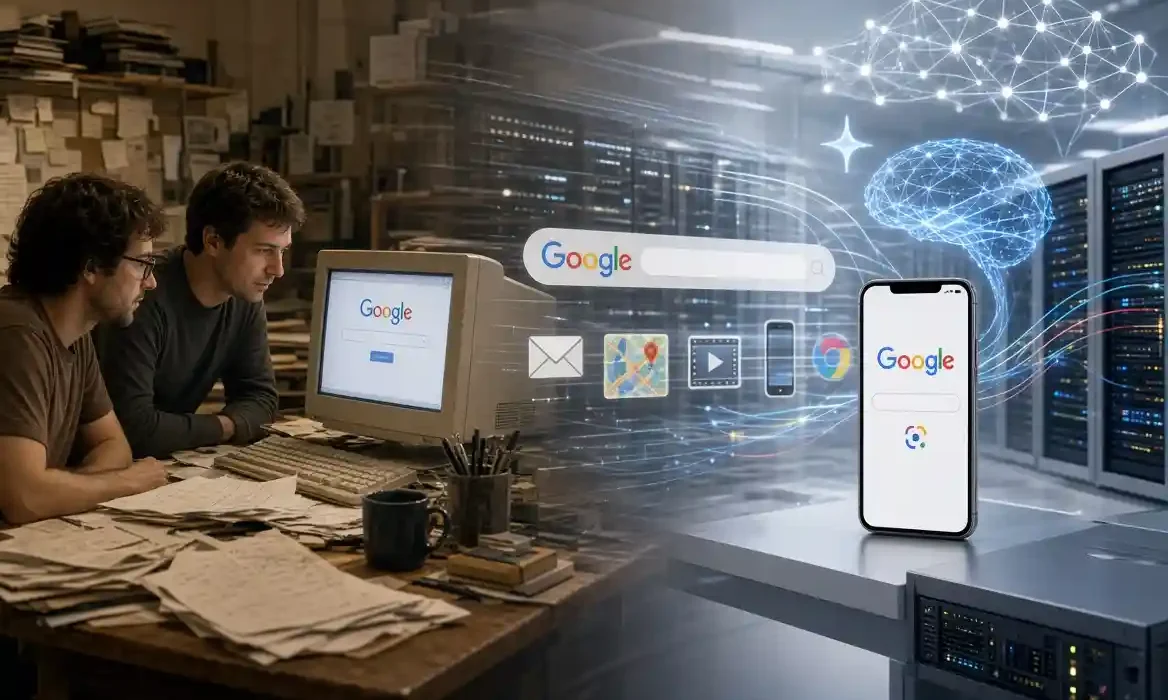
Page had an idea borrowed from academia. A research paper matters not just because of its own text, but because of who cites it. Brin, with a strong background in mathematics, knew how to turn that intuition into a system. Together they began working out of a cluttered office in the Gates Computer Science Building.
From BackRub to Google Search
Their first search engine was called BackRub. The name came from its core trick: it looked at backlinks — the links pointing to a page — to judge what was important.
Launched on Stanford’s servers in 1996, BackRub crawled the web and built an index of which pages linked to which. It was housed on hardware that Page and Brin cobbled together, including, famously, a case made from Lego bricks that could be expanded cheaply to hold more disks.
By early 1997 the system was already better than what existed. They had outgrown Stanford’s bandwidth. Fellow graduate students noticed that google. stanford.edu returned unusually relevant results.
The name changed in 1997. They settled on Google, a play on “googol,” the mathematical term for 1 followed by 100 zeros. It captured the mission: to organize an immense amount of information. The domain Google.com was registered on September 15, 1997.
Why PageRank Changed Web Search
The reason BackRub worked was PageRank, the algorithm Page and Brin described in their 1998 paper “The Anatomy of a Large-Scale Hypertextual Web Search Engine.”
The concept is simple to explain, even if the math is not. Every link from one page to another is treated as a kind of vote. But not all votes are equal. A link from a page that itself has many important links counts for more than a link from an obscure page nobody links to.
So if a page about telescopes is linked to by the astronomy department at Caltech, by NASA, and by a popular science magazine, PageRank reads those links as signals that the page is probably trustworthy and useful, even if the page doesn’t repeat the word “telescope” fifty times.
That was different from keyword-matching engines, which could be fooled by stuffing a page with hidden terms. PageRank made it much harder to cheat because you needed to earn links from other respected pages. For users in 1998, the effect was immediate: you typed something in and the first few results were actually what you wanted.
The Garage Years and Google’s First Big Break
Page and Brin tried to license the technology. They reportedly approached Excite, Yahoo and others. Nobody wanted to buy it, or the offers were too low. So they decided to start a company.
The turning point came in August 1998. Sun Microsystems co-founder Andy Bechtolsheim wrote a check for $100,000 made out to “Google Inc.” — a company that did not yet legally exist. To cash it, they had to incorporate.
Google Inc. was incorporated on September 4, 1998 in California. The team moved out of the dorms into its first office: a garage in Menlo Park owned by Susan Wojcicki, then a friend at Intel who would become employee #16 and later CEO of YouTube. The rent was $1,700 a month. There was a washer and dryer, a ping-pong table, and a blue carpet.
The garage story is true, but it was not just two students. Their first employee, fellow Stanford computer scientist Craig Silverstein, joined in 1998 and built crucial early infrastructure. Early advisor David Cheriton, a Stanford professor, also wrote a $100,000 check. By early 1999 they had raised $25 million from Kleiner Perkins and Sequoia, two firms that rarely co-invested.
The early servers were still cheap and idiosyncratic, but the index was growing fast — from 24 million pages in 1998 to over a billion by mid-2000. Word spread because search worked. Google.com’s homepage, famously stark with just a logo and a box, loaded fast when competitor portals were cluttered with news, weather and ads.
How Google Turned Search Into a Business
For its first couple of years Google had no real business model. That changed in 2000.
In October 2000 Google launched AdWords, later renamed Google Ads. The idea was not new — selling ads tied to search keywords — but Google’s execution was. Instead of charging companies for banner impressions, it charged only when someone clicked. And it ranked ads not just by who bid highest, but by how often people actually clicked them.
This is intent-driven advertising. If you search “buy hiking boots waterproof,” you are already close to buying. An ad at that moment is far more valuable than an ad on a generic news page. For small businesses, it meant they could reach a customer exactly when interest was highest without a massive budget.
In 2003 Google added AdSense, which let other websites show Google ads and split the revenue. Suddenly every blogger, news site and forum could make money from search advertising.
Search became the funding engine. A clean, useful product brought users. Users attracted advertisers. Advertiser money paid for more computers, more crawling, and better results. That loop is still at the center of Google’s finances, even as the company has grown far beyond it.
Google Expands Beyond Search
Once search and ads were working, Google started building — and buying — products that would keep people inside its orbit.
Some of the moves that mattered most:
- Gmail (2004): Launched on April 1, many thought it was a joke. One gigabyte of free storage when Hotmail offered 2 megabytes, plus fast search across your own email, made webmail usable again. It also gave Google a way to understand communication patterns and serve more relevant services.
- Google Maps (2005) and Google Earth (2005): Maps started from the acquisition of Where 2 Technologies. Satellite imagery and driving directions, then Street View in 2007, turned Google from a place you went to find websites into a place you went to find the physical world.
- Google Chrome (2008): Google built its own browser to make the web faster. Chrome’s speed and auto-updates helped it overtake Internet Explorer and Firefox. Owning the browser also meant Google could push new web standards and protect its search default.
- Google Cloud (2008 onward): What began as infrastructure for Google’s own products — App Engine, then Compute Engine — became a full cloud platform. Today it competes with AWS and Microsoft Azure and is a major home for AI workloads.
- Google Photos, Drive, and Workspace: Storage and productivity tools made Google the default for files and collaboration, especially after Drive launched in 2012.
The strategy was rarely random. Each new product increased the amount of time people spent with Google, produced more data to improve search and ads, and created another surface where advertising or subscriptions could work.
YouTube, Android and the Mobile Era
Two acquisitions in the mid-2000s changed Google more than any other.
YouTube. Founded in February 2005 by three former PayPal employees, YouTube was growing explosively but burning cash. Google announced it would buy YouTube for $1.65 billion in stock in October 2006. The deal closed that November. At the time it looked expensive for a site with little revenue. It turned out to be one of the best acquisitions in tech history. YouTube gave Google dominance in video, the format that would eat the internet. Today YouTube is the world’s largest video platform and, by itself, the second-largest search engine, with an advertising business that generates tens of billions annually.
Android. In July 2005 Google quietly acquired Android Inc., a tiny startup in Palo Alto building software for mobile phones. Co-founder Andy Rubin stayed on. The reason was strategic fear and opportunity. If phones were going to become computers, and computers were going to search, Google needed to ensure search stayed central on phones. By making Android open-source and free for handset makers, Google guaranteed its services — Search, Maps, Gmail, and later YouTube and Chrome — would be preinstalled on billions of devices. When Apple launched iPhone in 2007, Android was ready. By 2012 it was the most used mobile operating system in the world, and it remains so today.
The mobile shift fundamentally altered Google. Searches got shorter and more local. Ads had to work on small screens. Location data from Maps and Android made ads more valuable, but also brought new scrutiny over privacy.
The 2004 IPO and Google’s Rapid Growth
By 2004 Google was profitable and handling about 200 million searches a day, but it needed capital to build data centers. On August 19, 2004, it went public.
The IPO itself was unconventional. Instead of a traditional Wall Street roadshow where banks set the price, Google used a Dutch auction, allowing anyone to bid for shares. Page and Brin wrote a letter in the founders’ IPO letter that included the now-famous line “Don’t be evil” and argued the company would focus on long-term bets over quarterly targets.
It was messy. The initial range of $108 to $135 was cut, and shares ultimately priced at $85, raising $1.67 billion and valuing the company at about $23 billion. Investors who bought at $85 saw the stock rise 18% on day one. In the two decades since, that valuation has grown by more than seventyfold.
The money let Google build the infrastructure that its competitors could not match: custom servers, undersea cables, and data centers designed to run search in milliseconds.
Why Google Created Alphabet
By 2015 Google was running Search, YouTube, Android, Maps, Cloud, plus speculative projects like self-driving cars, life sciences, and internet balloons. Running all of that inside one company made it hard to explain to investors and to give each effort room to fail.
On August 10, 2015, Page announced a restructuring. A new parent company, Alphabet Inc., would be created. Google would become its largest subsidiary, focused on internet products. Other bets would become separate Alphabet companies, including:
- Waymo for autonomous driving
- Verily for life sciences
- Wing for delivery drones
- Other ventures under the “Other Bets” umbrella
The structure was simple: Alphabet would handle capital allocation. Page became Alphabet CEO, Brin became president, and Sundar Pichai, who had led Chrome and Android, became CEO of Google. The reorganization also clarified that Google was no longer just a search company; it was one business inside a larger technology holding company.
From Page and Brin to Sundar Pichai
Page and Brin stayed involved after 2015, but their public roles shrank. Pichai, who joined Google in 2004 after studying at IIT Kharagpur, and Wharton, had built a reputation as a product-focused operator who could ship Chrome, ChromeOS, and later oversee Search without drama.
On December 3, 2019, Page and Brin announced they were stepping back from day-to-day management of Alphabet. Pichai would become CEO of both Google and Alphabet. Page and Brin remained major shareholders, board members and controlling voters, and still advise on technology, but they no longer run operations.
Under Pichai, Google has become more centralized and more cautious about product launches, while investing heavily in AI infrastructure. He is now the public face of Google at I/O, in Washington, and in courtrooms where antitrust cases are heard.
Google Enters the AI Era
Google’s AI work did not start with chatbots. It started with trying to make search and infrastructure cheaper and better.
Google Brain was formed in 2011 by Jeff Dean, Greg Corrado and Andrew Ng as a research group working on large-scale neural networks using Google’s data centers. In 2014 Google acquired DeepMind, the London lab co-founded by Demis Hassabis, which had been working on reinforcement learning and games. DeepMind later solved protein folding with AlphaFold and beat the world Go champion with AlphaGo in 2016.
Google released TensorFlow as open-source in 2015, which became one of the most used machine learning frameworks. It built custom chips called TPUs (Tensor Processing Units) to run these models efficiently.
Through the late 2010s AI was embedded quietly: RankBrain and BERT to understand search queries, voice recognition in Assistant, translation in Translate, spam filtering in Gmail, and recommendation in YouTube.
The shift became public in 2022-2023 when generative AI moved from research papers to consumer products. In April 2023 Google merged Brain and DeepMind into a single unit called Google DeepMind to accelerate development.
Gemini
Gemini is Google’s family of multimodal AI models — meaning they are designed from the start to work with text, images, audio, video and code, not just text.
It was announced in December 2023, replacing the earlier PaLM models that powered Bard. Google developed it because it needed a single foundation that could be used across all its products, rather than separate models for Search, Workspace and Android.
Gemini comes in tiers — Nano for on-device use on Pixel and Android, Flash for fast everyday tasks, Pro for more complex reasoning, and Ultra for the most demanding work. As of 2026, Gemini powers:
- AI Overviews in Search, which summarize answers from the web instead of just listing links
- Gemini in Workspace (Docs, Sheets, Gmail) for drafting, summarization and data analysis
- Gemini on Android, gradually replacing Assistant as the default helper
- Developer tools in Google Cloud and AI Studio
Unlike a standalone chatbot, Gemini’s distribution advantage is that it is built into places people already use: when you search, when you open Gmail, when you pick up an Android phone. Google’s current strategy, laid out at I/O 2024 and 2025, is to make Gemini the intelligence layer underneath Search, Cloud and Android rather than just another app.
Where Google Stands Today
In 2026 Google is a subsidiary of Alphabet, which is one of the three most valuable companies in the world by market capitalization.
Search is still the core — it accounts for the majority of Alphabet’s revenue through advertising — but it is no longer what Google is. The company today operates across:
- Search and Ads: Including Search, Google Ads, AdSense and Shopping
- YouTube: Video, music, TV and its own ad and subscription business
- Android and Platforms: Android, Chrome, ChromeOS, and Play Store distribution
- Cloud: Google Cloud Platform and Workspace, increasingly sold on AI performance
- Hardware: Pixel phones, watches, and custom silicon including Tensor chips
- AI: Gemini models, DeepMind research, TPUs and AI infrastructure
- Other Bets: Waymo, which operates fully autonomous ride-hailing in several U.S. cities, and other Alphabet companies
Sundar Pichai leads Alphabet and Google. Page and Brin remain controlling shareholders. The original mission statement from 1998 — “to organize the world’s information and make it universally accessible and useful” — is still on Google’s website, but the way it does that now involves video, phones, cloud servers and large AI models, not just ten blue links.
Google’s 28-Year Journey in Perspective
What made Google’s growth different is not one trick. It was a combination that competitors have found hard to copy.
First, search quality. PageRank gave Google an early lead that was hard to overcome because better results brought more users, which produced more data on what people clicked, which improved results again.
Second, speed and simplicity. The homepage had no clutter. Results came back quickly because of heavy investment in distributed infrastructure, something Craig Silverstein and later Jeff Dean and Sanjay Ghemawat pioneered.
Third, the ad model. AdWords tied payment to actual clicks and to relevance, not just budget. That made ads useful to users and affordable to small advertisers, expanding the market.
Fourth, distribution. Acquiring Android and YouTube, building Chrome, and securing search defaults gave Google places to reach users beyond google.com.
And fifth, long-term research spending. Projects like Google Brain, DeepMind, Maps’ Street View cars, and Waymo looked expensive for years before they became core businesses. Eric Schmidt, who served as CEO from 2001 to 2011, often described his job as providing adult supervision while letting Page and Brin continue to bet on engineering.
Google at 28 looks less like a search engine company that branched out and more like an infrastructure company that started with search. The original Stanford project to catalog web links became a system for cataloging roads, videos, emails, books, genes and, now, the patterns inside AI models themselves. That expansion brought market power, antitrust scrutiny, and questions about privacy that did not exist when BackRub ran on Stanford servers. It also made the web far easier to navigate than anyone expected in 1998.
For a longer look at how the company tells its own story, see Google’s official history and the source feature that inspired this research: Storyboard18 on Google at 28.