
 By
By So, What’s the Catch With Space Exploration?
Everyone loves a good rocket launch. There’s something almost cinematic about it—the countdown, the ignition, that slow, powerful lift off. It feels like progress. Like we’re moving forward as a species.
But here’s the thing people don’t talk about enough:
Progress in one direction usually means compromise somewhere else.
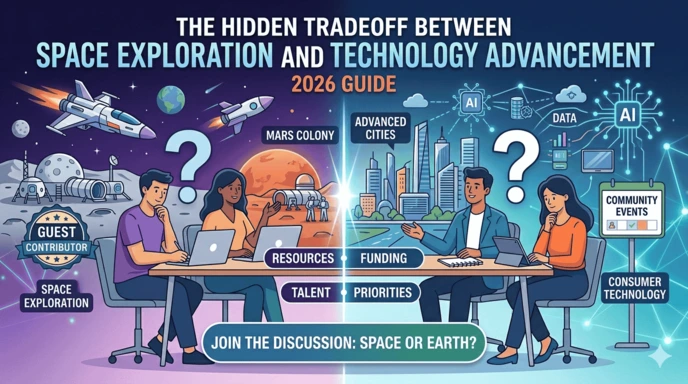
Space exploration has given us incredible technology. No debate there. But it also quietly pulls resources, attention, and priorities away from problems sitting right here on Earth.
That’s the hidden tradeoff.
Why Space Exploration Feels So Important
To be fair, space exploration isn’t just about curiosity. It’s about survival, innovation, and sometimes even national pride.
A lot of the tech we rely on today didn’t start on Earth in the usual sense. It came from solving problems that only exist in space—extreme temperatures, zero gravity, isolation.
Think about:
GPS systems you use every day
Weather forecasts that actually work
Even some medical imaging tools
None of these would look the same without space research.
So yes, space exploration pushes technology forward in ways few other industries can.
But Here’s Where Things Get Complicated
The problem isn’t space exploration itself.
It’s what it costs us—not just financially, but in terms of focus and priorities.
1. The Money Question Nobody Likes Asking
Space programs burn through billions. Not millions—billions.
And while that funding does lead to breakthroughs, you have to ask:
What if even a fraction of that money went into:
Public healthcare systems
Education access
Climate solutions
It’s not about saying space isn’t important. It’s about acknowledging that resources are limited.
Every dollar spent up there is a dollar not spent down here.
2. Innovation Isn’t Evenly Distributed
Here’s another uncomfortable truth.
The benefits of space-driven technology don’t reach everyone equally.
New tech usually starts expensive. It takes years—sometimes decades—before it becomes accessible to average people or developing regions.
So while one part of the world is benefiting from cutting-edge advancements, another is still struggling with basics.
That gap? Space innovation can quietly widen it.
3. Environmental Cost (Yes, Even Space Has One)
Rockets don’t just disappear into the sky without impact.
They leave behind:
Emissions
Chemical residues
Debris orbiting Earth
That last one—space debris—is becoming a real issue. We’re basically cluttering Earth’s orbit with junk that could eventually make future missions harder or riskier.
It’s ironic, isn’t it?
In trying to explore beyond Earth, we’re creating problems around it.
4. The Shift Toward Competition, Not Curiosity
Space used to feel like a shared human mission.
Now? It’s also about control.
Countries—and increasingly private companies—are racing for dominance. Satellites aren’t just for communication anymore; they’re strategic assets.
Which means technological advancement in space can also fuel tension back on Earth.
So… Is It Worth It?
This is where it gets tricky.
Because despite all these tradeoffs, stopping space exploration doesn’t make sense either.
Without it:
Innovation would slow down
We’d lose valuable scientific insight
Long-term survival strategies (like planetary backup plans) disappear
But going all-in without thinking about consequences isn’t smart either.
Maybe the Real Issue Isn’t Space—It’s Balance
The real problem isn’t that we explore space.
It’s that we don’t always balance that ambition with responsibility.
We chase breakthroughs, but we don’t always ask:
Who benefits first?
Who gets left behind?
What are we delaying on Earth while we invest in space?
That’s the tradeoff people feel—but rarely put into words.
Where Things Might Be Headed
Looking ahead, things could shift in a better direction.
We’re already seeing:
Reusable rockets reducing costs
More collaboration between countries
Conversations around sustainable space practices
If that continues, the tradeoff might not disappear—but it could become more manageable.
Final Thought
Space exploration isn’t the problem.
Blind optimism about it is.
It’s easy to look at a rocket launch and see only progress. It’s harder—but more honest—to ask what that progress is costing us elsewhere.
And maybe that’s the real challenge:
Not choosing between Earth and space, but making sure advancing one doesn’t quietly harm the other.
FAQs
What is the hidden tradeoff in space exploration?
It’s the balance between technological progress and the cost of achieving it. While space exploration drives innovation, it also consumes resources that could be used for urgent issues on Earth.
Does space exploration really help everyday life?
Yes, but often indirectly. Many technologies we use today started as solutions for space-related problems, though they take time to become widely accessible.
Why is space exploration so expensive?
Because it involves complex engineering, high-risk missions, and advanced research. Even small failures can cost millions, which adds to overall expenses.
Is space exploration bad for the environment?
It has environmental impacts, including emissions and space debris. While not the biggest contributor globally, its effects are growing as launches increase.
Can we reduce the tradeoffs?
Yes, through better planning, sustainable practices, and ensuring that technological benefits are shared more equally across the world.