 By
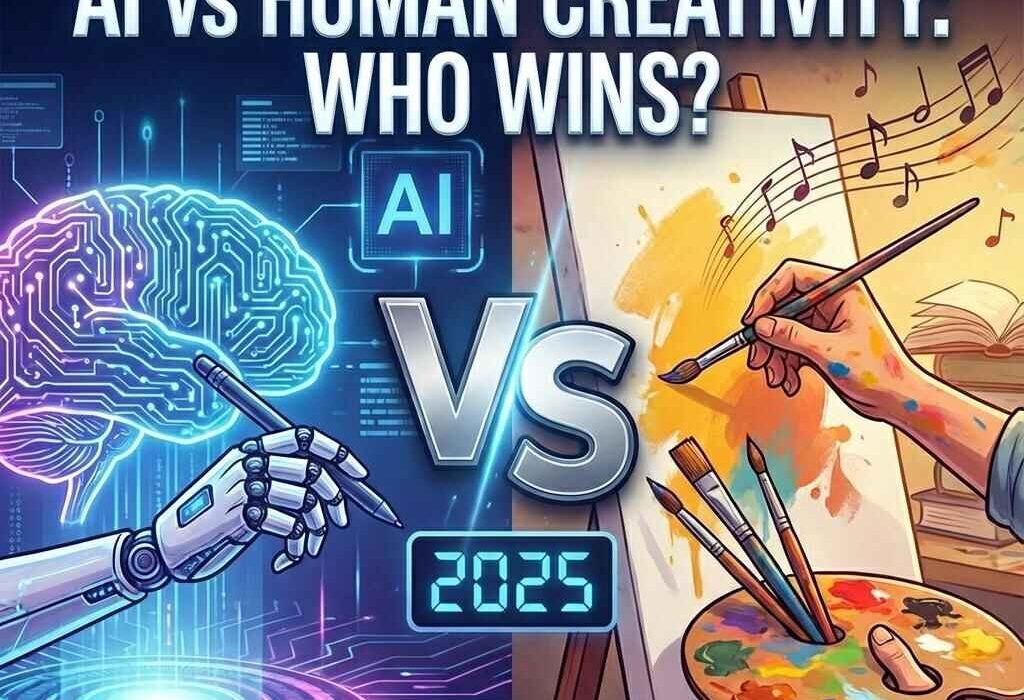
By The argument about whether AI or people are more innovative is still continuing strong in 2026. Grok 3, DALL-E 4, and Midjourney v7 are tools that can make art, music, and copy faster than ever before. But people produce things with emotions, gut feelings, and cultural depth that AI can’t imitate. This comparison of AI creativity looks at how creative individuals and AI are, how AI-generated content is changing, and how AI could work together in creative fields.
Does AI replace artists, or amplify them? Let’s break it down.
AI Creativity Comparison: Machines vs Minds
AI creativity comparison shows distinct approaches:
Artificial Intelligence Strengths:
- Speed & Scale: Generates 1,000 logo variations in seconds vs human hours.
- Pattern Mastery: Analyzes millions of artworks, spotting trends that humans miss.
- Consistency: Perfectly executes styles without fatigue.
Human Strengths:
- Emotional Resonance: Infuses lived experience, vulnerability, and cultural nuance.
- Rule-Breaking: Intentionally defies conventions for breakthrough impact.
- Contextual Genius: Reads audience psychology, timing, and cultural shifts.
2024 studies confirm AI boosts individual creativity 25-40% but reduces collective diversity, as everyone’s output converges.
Human vs AI Creative Ability: The Real Test Cases
Art & Design
The future of AI in art: Midjourney makes sceneries that look like photos, but it doesn’t have Banksy’s social commentary, Mozart’s attention to detail, or Picasso’s ability to change emotions. People are great at making metaphorical jumps.
Writing & Copy
AI writes 10 times faster, yet ChatGPT has trouble sounding real. When human copywriters combine persuasion with empathy, the conversion rates go up by about 15%.
Music Composition
Suno.AI has great hooks, but it doesn’t have Radiohead’s haunting vulnerability or Beethoven’s structural genius. Humans make up new genres, while AI remixes old ones.
AI-generated content trends 2025: 60% of marketers use AI drafts; humans refine for brand voice.
How AI Works Creatively (The Black Box)
AI creativity stems from transformer models trained on vast datasets:
- Pattern Recognition: Learns correlations (red cars + sunsets = dramatic).
- Interpolation: Blends training data into novel combinations.
- Diffusion: Iteratively refines noise into coherent outputs.
Limitation: No consciousness, emotion, or intentionality. AI recombines; humans originate from experience.
Human Creativity Advantages: What AI Can’t Touch
Human creativity advantages shine in:
- Emotional Intelligence: Creates work that feels human—empathy drives connection.
- Cultural Nuance: Understands irony, taboo, and local context.
- Strategic Intent: Breaks rules deliberately for impact.
- Iterative Evolution: Refines based on lived feedback loops.
Adobe’s 2025 report: Approximately 60% creatives say AI handles grunt work, freeing humans for visionary strategy.
Ethical Issues in AI Creativity: The Dark Side
Ethical issues in AI creativity dominate 2025 debates:
- Copyright Theft: Trained on stolen art without permission (NYT case still going on).
- Job Loss: 30% of graphic design jobs are mechanised, and artists are moving to AI prompting.
- Authenticity Crisis: People don’t like “soulless” AI content (40% of TikTok videos are fake).
- Bias Amplification: AI reproduces dataset biases in created faces/text.
UK regulations mandate AI labeling by 2026.
AI in Creative Industries: Collaboration Wins
AI in creative industries 2025 reality:
- Marketing: AI drafts; humans personalize (HubSpot: 40% productivity gain).
- Film: Sora generates storyboards; directors craft narrative.
- Music: AI co-produces beats; vocalists deliver soul.
Best outcomes: Human-AI teams outperform solo creators 25%.
The Future: Symbiosis, Not Replacement
Future of AI in art & creativity points to partnership:
- 2026: Real-time co-creation (AI suggests; human approves).
- 2030: Brain-computer interfaces blend thought-to-art.
- Verdict: AI amplifies human bandwidth; humans supply soul.
Research: 62% Americans fear AI harms creativity, yet 90% creatives report gains.
Frequently Asked Questions (FAQs)
Can AI be more creative than humans?
No. AI excels at speed/pattern recombination (1,000 ideas/sec), humans at emotional originality and rule-breaking. 2025 studies show AI boosts individual creativity 40% but reduces diversity. True innovation needs human intuition.
Will AI replace human creativity?
It is highly unlikely. However, AI handles execution (drafts, variations), and humans provide vision/emotion. Adobe: 60% creatives use AI for grunt work, producing better results. Collaboration yields 25% higher quality than solo work.
What are AI vs human creativity differences?
AI: Data-driven, consistent, fast. Human: Emotional, contextual, breakthrough. AI lacks consciousness; excels at scale. Human-AI teams outperform both by 25-40% per 2025 research.
Is AI art real creativity?
AI art recombines training data patterns that are impressive technically, but lack intentionality/emotion. Humans create from experience. Ethical debates rage over copyright; audiences prefer “human-made” labels.
How does AI affect creative jobs?
Artificial Intelligence (AI) automates 30% routine tasks (logo generation, copy drafts), and creatives pivot to strategy/AI prompting. Net Gain: 40% productivity. UK mandates AI disclosure 2026.
Conclusion
AI vs human creativity isn’t zero-sum. AI scales execution, humans supply soul. Human creativity advantages endure while AI-generated content trends reshape workflows. Navigate ethical issues in AI creativity wisely.
While it’s thought that AI is taking jobs of humans at scale, AI and human collaborations is where the real deal is. Humans created AI, and they can take it to the next level with them, while taking themselves to the next level, with AI. The quicker you understand this, the better it results in your favor.
The future of AI in art favors hybrid teams. Experiment with tools; hone your unique voice. UKTechWire tracks AI in creative industries. Stay ahead of everyone else with the information provided in our blogs!

Jalees Ur Rehman is an SEO professional with 13+ years of experience in SEO and Digital Marketing. He helps businesses grow organic traffic and conversions through data-driven digital marketing strategies and practical execution.